You’re standing in a store aisle or scrolling late at night, trying to buy something for a child who isn’t your own, or maybe isn’t even the same age as your child. The birthday party is tomorrow, the child loves dinosaurs this month and Roblox next month, and the obvious options all feel either too small, too generic, or too risky. A birthday basket for kids solves that problem because it turns one rushed purchase into a tiny celebration, with a few pieces that feel chosen on purpose instead of grabbed in panic.
That’s the charm of a basket. It’s not just a container full of things. It’s a mini party in a box, a way to combine something fun, something useful, and something personal without needing a giant budget or a full afternoon of shopping. When the mix is right, the child opens it and immediately sees play value, not just “stuff.”
Introduction to Birthday Baskets That Make Kids Light Up
A birthday basket works like a small sampler of celebration. Instead of betting everything on one toy that may be too advanced, too young, or too fragile, you spread the delight across a few smaller wins. One item can invite play, another can be worn or read, and a third can extend the fun after the wrapping paper is gone.
That format helps when the gift needs to be quick, thoughtful, and age-aware. A parent shopping for a niece, a teacher choosing for a student, or a grandparent trying to avoid duplicate gifts can all use the same structure, then adjust it for age, interests, and safety. A birthday basket for kids also fits the way many families budget for birthdays. In a 2023 consumer survey, Americans reported spending an average of $83 on kids’ birthday gifts, while the average kids’ birthday party itself cost $314, and 20% of parents said they spent more than $500 on the celebration, excluding gifts, according to birthday party statistics.
That spending pattern matters because the gift often sits beside, not inside, the party budget. The basket does not have to match the cake, venue, or decorations. It only needs to feel considered and right for the child.
Practical rule: A great basket should feel like a small celebration, not a random pile of sale items.
The rest of this guide starts with the basics, then moves through age fit, themes, safety, and buying confidence. If you have ever wondered whether a basket should lean toy-heavy, snack-heavy, or activity-heavy, the answer gets clearer once you know what to check first.
What Makes a Birthday Basket for Kids Truly Work
A strong basket needs balance. Like a lunchbox that gets eaten or a playground that kids keep returning to, there should be variety, a clear purpose, and no awkward pieces that don’t belong together. The best baskets usually combine one attention-grabber, one practical or reusable item, and one detail that makes the gift feel personal.
The three things that matter most
The first filter is age fit. A preschooler and a tween can both love a basket, but they won’t love the same contents. The second is theme cohesion, which means the items should feel like they belong to one playful world, even if they’re not identical. The third is safety, because a cute basket that ignores allergies or small-parts risk is not a good basket.
That’s where curated discovery helps. A platform like Kudosz organizes handpicked gift baskets and themed sets by occasion, then links shoppers through to trusted merchants instead of asking them to stitch everything together from scratch. That matters when you want a fast comparison between a snack basket, a craft basket, or a character-themed bundle without wandering across dozens of random listings.
The broader gift-basket category has become a meaningful consumer segment, with several industry summaries estimating global market value in the low-to-mid tens of billions of dollars and continued expansion through the 2030s, and about 61% of online shoppers bought a gift basket in 2023 while 78% of gift baskets are purchased for birthdays, according to gift basket statistics and facts. That’s a strong signal that baskets already fit how people shop for birthday occasions.
A quick way to judge any basket
Look for these parts:
- A clear main item: This could be a toy, a book, a craft kit, or a soft accessory.
- A supporting item: Something like stickers, bubbles, crayons, or a small snack package adds variety.
- A carry-home factor: Reusable packaging, a box the child can keep, or a basket that doubles as storage makes the gift feel more complete.
A basket that looks cute but has no play path usually gets forgotten fast.
If you want a simple mental test, ask whether the child can open it and immediately know what to do with at least one item. If the answer is yes, the basket is already halfway there.
Choosing Age Appropriate Birthday Basket Ideas by Stage
A birthday basket works best when it fits the child in front of you. A toddler basket and a tween basket can both be delightful, but they solve different problems. One should be safe for tiny hands and short attention spans. The other should feel a little more independent, more personal, and less likely to read as babyish.
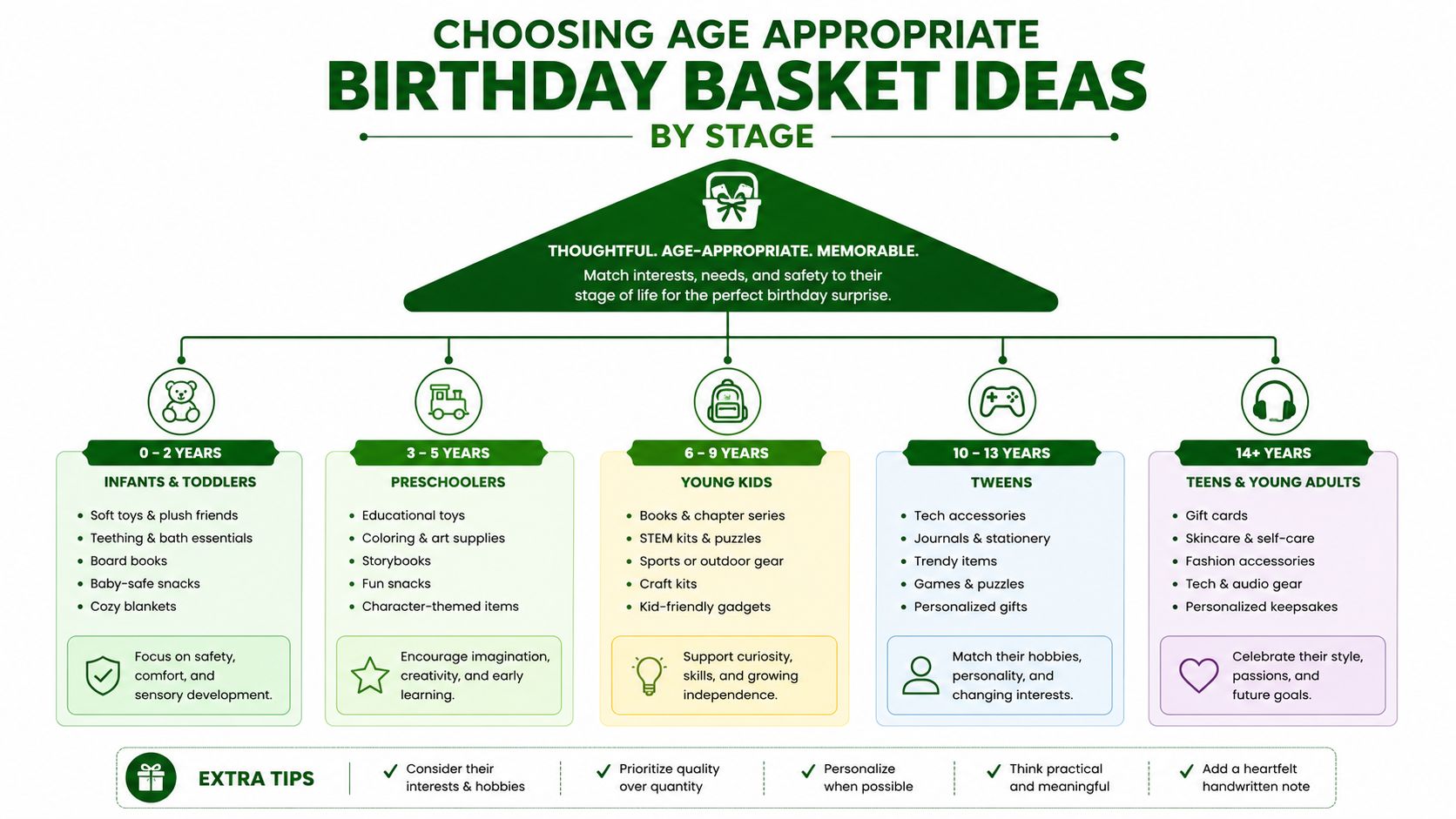
Age also shapes how much families are willing to spend on a birthday gift. Market summaries show higher spending for older children, which makes sense because older kids often expect more customized items. That does not mean every older child needs a larger basket. It means the basket should match the child’s stage, not just aim for “cute.”
Toddlers and preschoolers
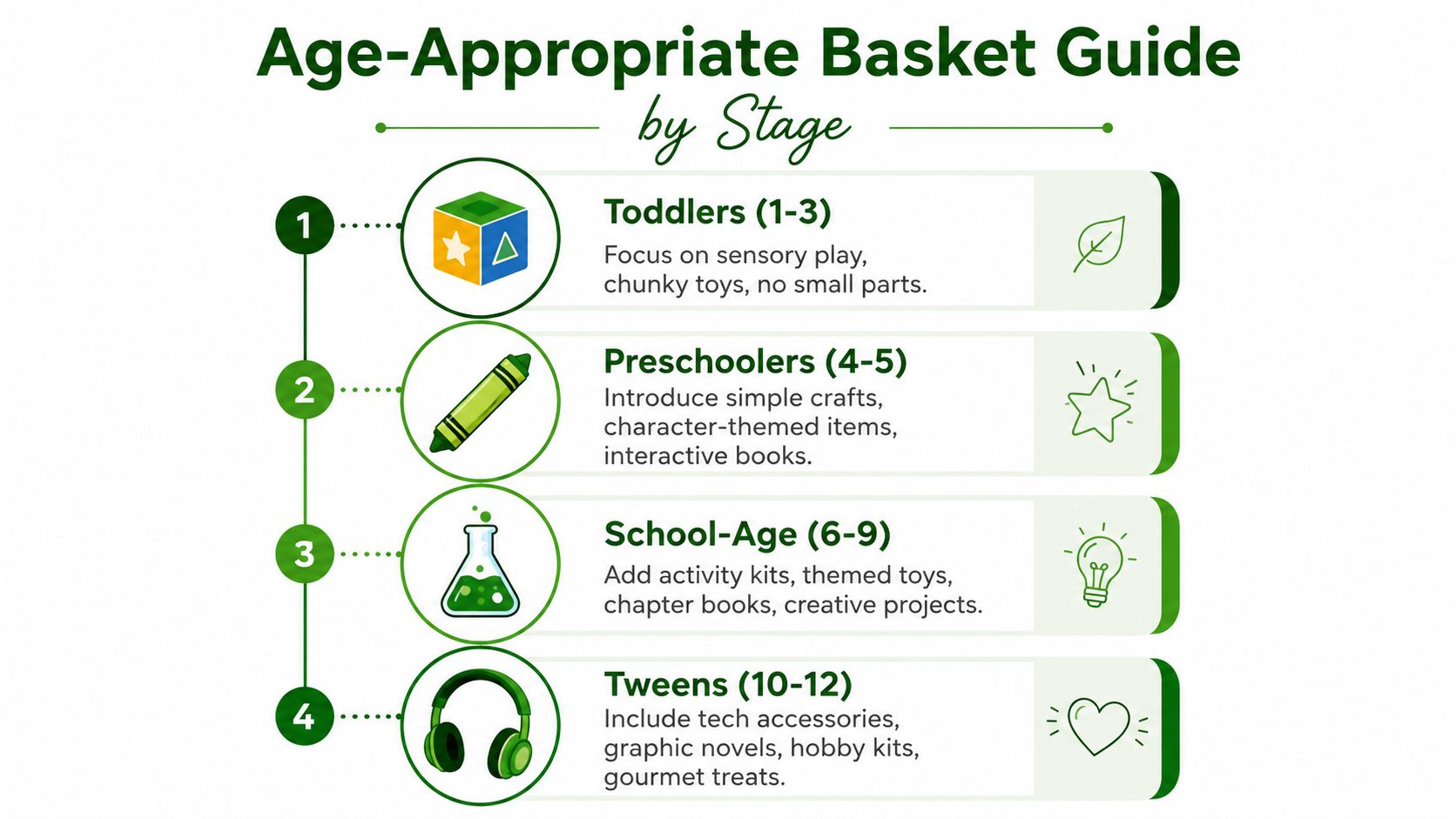
For ages 1 to 3, keep the basket simple, chunky, and sturdy. Board books, soft toys, stacking toys, bath toys, and large crayons fit well. Skip tiny parts and anything that needs tricky assembly. If you add food, keep it clearly packaged and easy for an adult to supervise.
For ages 4 to 5, you can bring in simple crafts, character items, interactive books, and basic pretend-play pieces. A basket at this stage can start to feel like a small story instead of a pile of objects. Stickers and a plain coloring pad often do more than a basket full of random extras.
School-age kids and tweens
For ages 6 to 9, activity kits, chapter books, science sets, collectible cards, and creative projects usually land well. Kids here want a basket that gives them something to do, not just something to own. Themes tied to current favorites, like animals, sports, or a favorite show, can help the gift feel instantly right.
For ages 10 to 12, shift toward items that feel a bit more grown-up, such as graphic novels, hobby kits, accessories, and themed treats. Many kids at this age want a basket that respects their taste. One strong item paired with a few supporting pieces often works better than a basket packed just to look full.
Quick safety note: If a child’s allergy status is unknown, non-food gifts are the safest default.
Age checks can also be a simple filter. Use the basket like a good seatbelt, it should fit the child before it decorates the party.
- 1 to 3: big parts, soft textures, simple play
- 4 to 5: pretend play, crafts, picture-heavy books
- 6 to 9: activities, collections, creative building
- 10 to 12: hobbies, accessories, reading, personal style
Themed Birthday Basket Examples That Match How Kids Celebrate Now
Kids don’t celebrate like they did even a few years ago. Current party planning leans toward experience-first parties, DIY activities, micro-parties with fewer guests, screen-free play, and themes like Bluey, Roblox, dinosaurs, mermaids, and glow or neon formats, according to best gift basket coverage. That shift changes what a good basket looks like. The best ones now feel like a little play kit, not a stuffed display.
Make the basket part of the activity
A dinosaur basket works better when it includes a small dinosaur figure plus a dig kit, coloring pages, or a fossil scavenger clue. A Bluey-inspired basket can lean into imaginative play with stickers, a book, and a little prop that helps kids act out scenes. A Roblox-style basket doesn’t need to copy the game directly. It can focus on creative building, puzzle play, or a themed notebook and pen set that fits the same energy.
The idea is to pair a physical gift with something the child can do. That can be as simple as a craft card, a mini challenge, or a reading prompt. The basket becomes useful after the party, which makes it feel bigger than the number of items inside.
Match the basket to the kind of party
If the party is small and activity-based, choose a compact basket with one toy, one project, and one keepsake. If the child is traveling or heading to a park birthday, keep the bundle portable. If the family is doing a screen-free weekend, build around puzzles, art, and outdoor play.
A helpful source for browsing more theme ideas is birthday basket ideas from That Blanket Co. Use it as inspiration, then filter every suggestion through the child’s age and interests instead of copying the format exactly.
A smaller basket that supports play often beats a bigger one that runs out of steam after the ribbons come off.
Theme pairings that work especially well
- Dinosaurs: figure, activity sheet, book
- Glow or neon: glow sticks, small game, dark-room play item
- Mermaid: craft piece, sticker set, storybook
- Outdoor play: bubbles, sidewalk chalk, reusable bag
- Creative kid: markers, notebook, project kit
The smartest baskets today feel purposeful. They don’t just match a theme, they extend it.
Safety First Allergy Aware and Sensitive Skin Basket Tips
A birthday basket can go wrong in a very ordinary way, by hiding a risk the shopper didn’t notice. For food-allergy households, the biggest danger is hidden allergen exposure. Common triggers include wheat, dairy, eggs, soy, fish, shellfish, peanuts, and tree nuts, and even products that don’t list those ingredients can still be unsafe when the label says shared-facility processing or may contain, according to allergy-friendly treat guidance.
Food baskets need label discipline
If you’re including snacks, read every ingredient panel and every precautionary statement. Ingredient-list compliance alone doesn’t guarantee safety for a sensitized child. Separate utensils and clean storage matter too, especially if the basket includes mixed items that might touch one another during packing or handling.
For unknown allergy status, the cleaner choice is often to skip food entirely. Allergy-focused guidance recommends toys, books, trading cards, bubbles, and glow sticks because they remove ingredient ambiguity and cross-contact worry, according to non-food rewards for children with food allergies.
Sensitive skin and scent issues deserve the same care
Some children react to fragrance, texture, or fabrics long before anyone labels them “allergic.” For those baskets, choose fragrance-free bath items, dye-free materials when possible, and textiles with certifications like GOTS or OEKO-TEX if you’re buying soft goods. Avoid strong inherent scents from materials like cedar or heavily scented fillers if the child is sensitive.
Rule of thumb: If the recipient’s body chemistry is a mystery to you, pick items with fewer ingredients and fewer coatings.
Quick safety check for kids’ birthday baskets
| Basket Type | Best When | Safety Check |
|---|---|---|
| Snack basket | The child’s allergy profile is known | Verify every label and precautionary statement |
| Toy basket | You want a low-risk default | Check for age grade and small parts |
| Craft basket | You want hands-on play without food risk | Avoid scented supplies and confirm washable materials |
| Soft-goods basket | You want something cozy | Look for fragrance-free, dye-conscious fabrics |
| Mixed basket | You want variety | Keep consumables separate from non-food items |
If you’re unsure, a basket built around books, toys, or activity supplies is usually easier to give confidently. Fun doesn’t have to come with guesswork.
Understanding Price Tiers and Where to Find Trusted Baskets
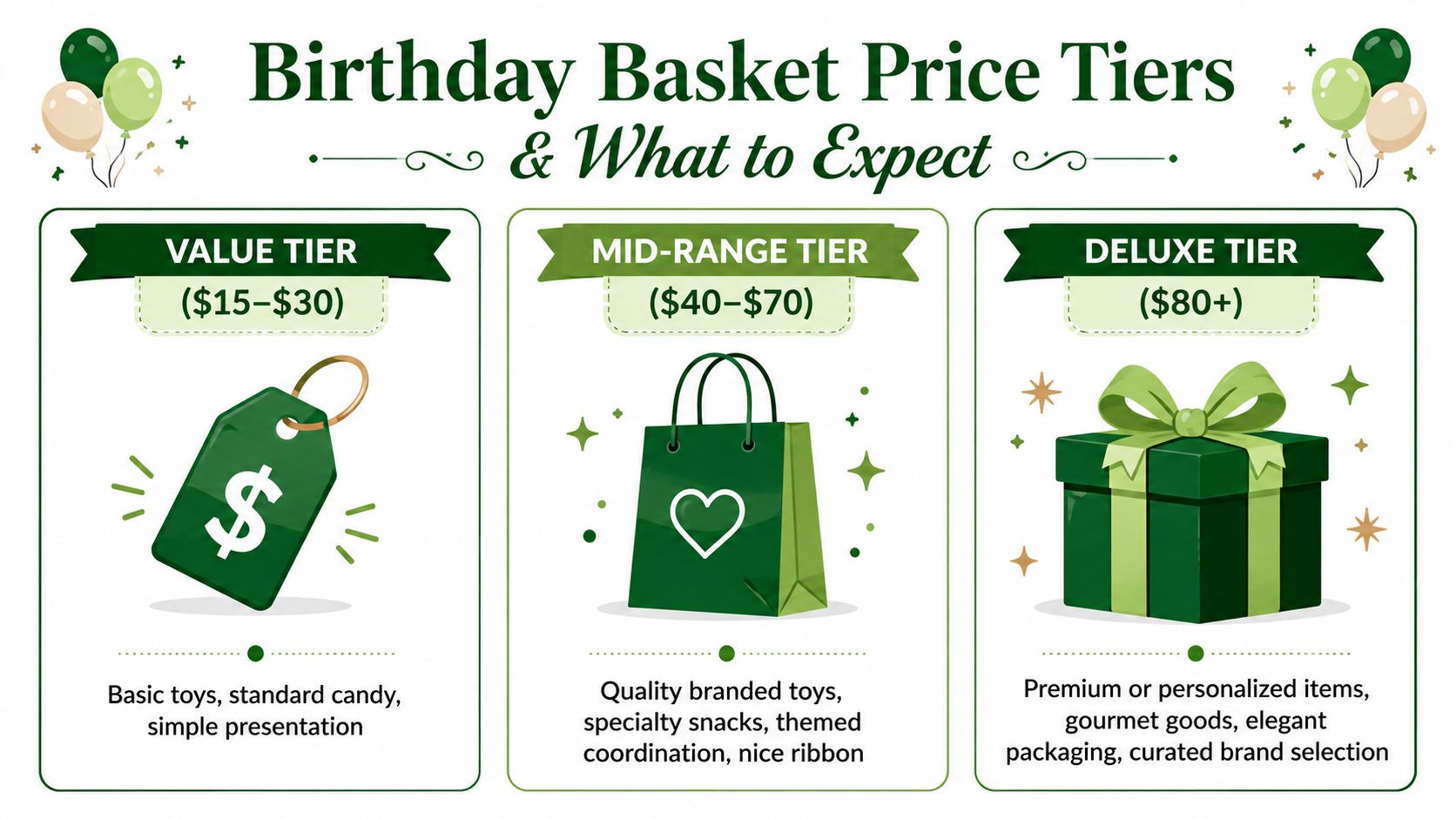
A birthday basket can fit the budget without feeling generic. The trick is to match finish, presentation, and contents to the occasion, then choose a tier that feels right for the child and the relationship. For kids’ birthday baskets, a simple way to sort the options is value, mid-range, and deluxe.
Value, mid-range, and deluxe
- Value tier: Basic toys, standard candy, and simple presentation. This fits classroom gifts, casual invites, or any moment where you want the basket to feel cheerful without becoming elaborate.
- Mid-range tier: Better branded toys, specialty snacks, themed coordination, and a nicer ribbon or box. This works well for nieces, nephews, close friends, and many birthday plans.
- Deluxe tier: Premium or personalized items, gourmet goods, elegant packaging, and a more curated selection. Choose this when the relationship is close or when you want the basket to feel especially memorable.
An average gift spend window of $83 gives a useful reference point for kids’ birthday gifts. That figure does not mean you need to spend that much. It shows that birthday budgets often leave room for a basket with real finish instead of a token item.
What changes as price rises
Lower price points buy function and charm. Higher price points usually bring stronger presentation, better branding, and packaging that feels more polished in the child’s hands. A premium snack assortment or a personalized bundle can feel more substantial because the pieces are chosen to work together, not just sit in the same container.
Look for freshness guarantees on edible items, sturdy reusable containers, and packaging that holds its shape until the gift gets home. If you are comparing options quickly, curated discovery helps reduce scattershot shopping. One option is Kudosz, which organizes birthday baskets from selected merchants and sends you through to the retailer to complete the purchase, so you can compare presentation and theme without assembling the whole thing yourself.
If the basket looks beautiful but arrives damaged or stale, the price tier does not matter.
Spend for impact, not bulk. A compact basket with better pieces usually feels more generous than a large one filled with filler.
Finding Your Perfect Birthday Basket for Kids With Confidence
The best birthday basket for kids usually wins on three things, age fit, theme relevance, and safety. If those three line up, the basket feels intentional even when it’s simple. If one of them is off, the whole gift can feel confusing, no matter how cute the packaging looks.
That’s why compact, experience-friendly baskets often land better than oversized ones. Kids want something they can use, not just something they can unwrap. Parents want gifts that fit the celebration without adding stress. And when food allergies or sensitive skin are part of the picture, the safest gift is often the one that doesn’t ask the child to guess what’s inside.
If you’re ready to shop, keep your decision checklist short. Start with the child’s age, then pick a theme or activity style, then decide whether the basket should be food-free. If you want an easier path to curated options, browse Kudosz graduation gift baskets and move through its occasion-based collections the same way you would compare birthday sets. The format is straightforward, and that makes last-minute buying a lot less chaotic.
Choose the basket that feels playful, practical, and safe. Then send it with confidence, because the right compact bundle almost always beats a random pile of bigger things. If you’ve got a birthday on the calendar this week, pick one age band, one theme, and one safety rule, then place the order today so the gift arrives ready to delight.