

A useful way to rethink the hunt for the best credit cards is this: Americans appear to be carrying fewer cards overall, yet choosing rewards more deliberately. Experian data cited by Synchrony says the average number of credit cards per person fell from 4.15 in 2017 to 3.9 in 2023, while a 2024 Ipsos poll found 71% of people have at least one rewards or points card, and a November 2024 Bankrate survey found 50% said cash back was the best feature of their most-used rewards card (Synchrony’s summary of those figures).
That changes the whole conversation. The best credit cards in 2026 aren’t just the ones with the biggest welcome offer or the flashiest ad. They’re the cards that produce the highest effective value after you account for annual fees, category limits, redemption friction, and whether you use the perks.
A premium travel card can be a smart choice for one household and a waste of money for another. A plain cash back card can look boring and still outperform a premium card if your spending is broad, irregular, or mostly outside bonus categories. The right comparison isn’t card versus card. It’s card structure versus your real budget.
Navigating the 2026 Credit Card Market
Credit card competition in 2026 is less about adding more cards and more about earning a clear return from each one. Issuers still market large welcome bonuses and premium perks, but the stronger comparison is ongoing value: what a card pays back over a full year after fees, spending caps, and unused credits.
That shift changes how a “best credit card” list should be read. A card with a rich sign-up offer can still be a weak long-term fit if your normal purchases do not support its rewards structure. A plain 2% cash back card can produce more usable value than a premium travel card if your spending is spread across everyday categories and you will not use lounge access, hotel status, or monthly statement credits.
The practical test is simple. Compare each card’s likely annual rewards to its annual cost, then adjust for how much effort the card asks from you. If a $95 fee card gives you $140 in realistic cash back and credits you would have used anyway, the net value is positive. If a $550 travel card offers strong theoretical perks but you would redeem only a small share of them, its effective value may be negative even with a large headline bonus.
That is why tighter card selection can signal smarter behavior, not less interest in rewards. Cardholders appear to be judging products more like budget tools and less like collectibles. Analysts who follow the broader field of consumer finance can see the same product packaging across checking, lending, and cards in this overview of banking and personal finance firms.
Approval standards also shape the market. The highest-value offer on paper is irrelevant if your credit profile does not qualify or if the issuer assigns a lower starting limit than your spending requires. Before comparing rewards tables, review issuer expectations and application basics in the Superior Credit Repair card guide.
A useful rule follows: choose the card that fits your current budget with the fewest assumptions. The winners in this market are often the cards that keep producing value in ordinary months, not just in the first 90 days.
How to Choose the Right Credit Card for You
NerdWallet’s comparison guidance points to the benchmarks that matter most: sign-up bonus value, required spending, base rewards rate, introductory APR terms, foreign transaction fees, and redemption flexibility. Its core conclusion is simple. The best card is the one whose structure matches your actual spending pattern (NerdWallet’s card comparison criteria).
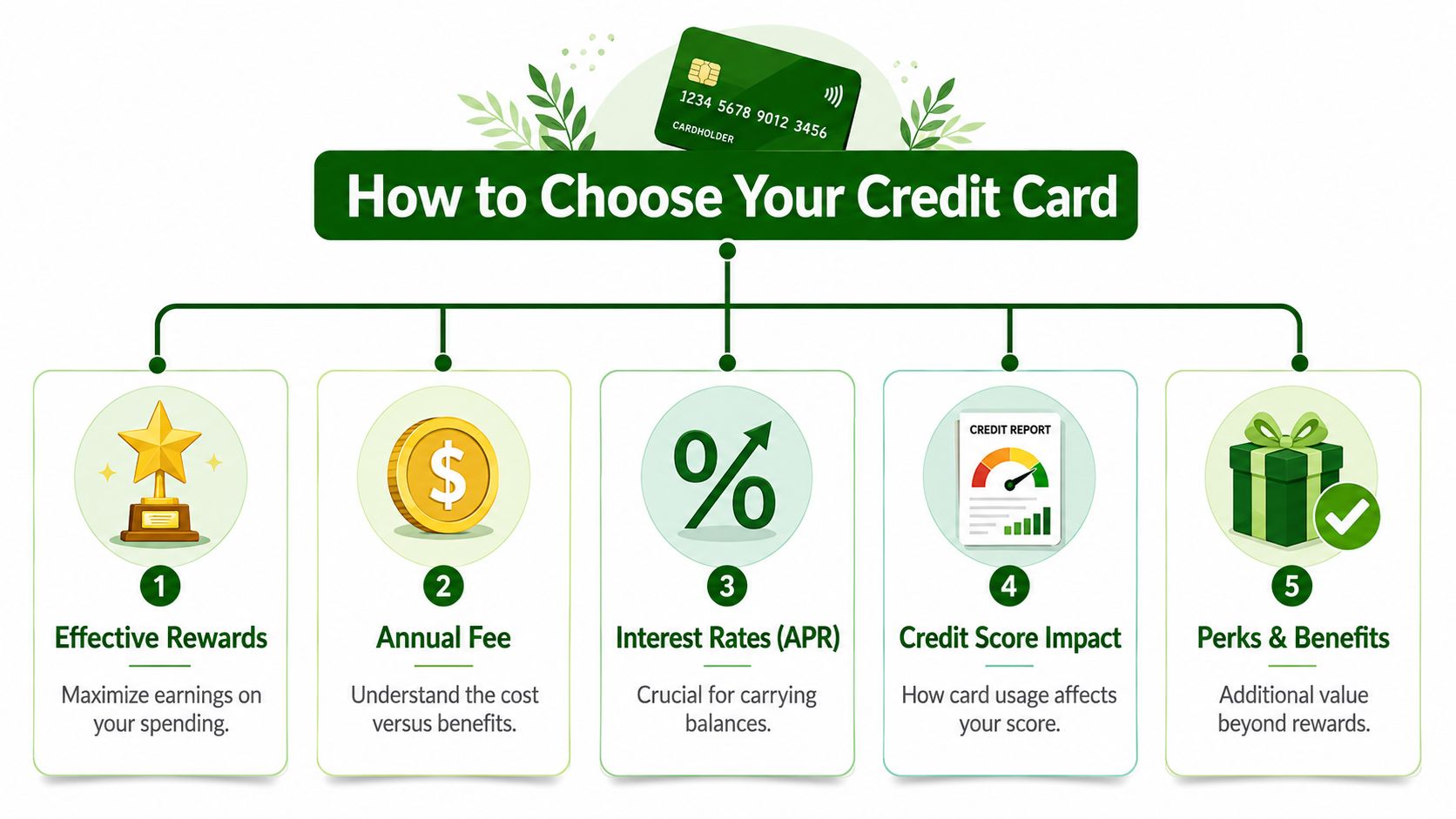
Start with your effective rewards rate
Headline earn rates can mislead. A card that advertises higher rewards in a few categories may still underperform a flat-rate card if most of your spending lands elsewhere.
Look at your last few statements and group purchases into rough buckets such as groceries, dining, gas, travel, general shopping, and bills. Then ask one question: where does most of the money go? Your effective rewards rate comes from that answer, not from the highest multiplier printed on the marketing page.
Test the annual fee against likely use
Annual fees aren’t automatically bad. They’re only bad when the card’s recurring value doesn’t cover them.
A simple way to understand:
- Fee first: treat the annual fee as a cost that must be earned back.
- Rewards second: estimate what the card would return on your normal spending.
- Perks last: only count benefits you already use, such as travel credits, lounge access, or statement credits tied to habits you already have.
If a card forces you to spend differently just to feel “ahead,” the fee is probably too high for your current profile.
Check whether the bonus is realistic
A welcome offer has value only if you can earn it without distorting your budget. Required spending matters as much as the bonus itself.
That’s where screening tools can help. If you’re also trying to understand approval standards before applying, the Superior Credit Repair card guide gives a practical overview of credit card requirements and approval considerations.
Practical rule: Ignore any sign-up bonus you can’t meet through planned spending.
Don’t underrate APR and redemption friction
If you sometimes carry a balance, introductory APR terms deserve more attention than rewards copy. A lower-cost borrowing window can be more valuable than points you may redeem later.
Redemption flexibility matters too. Some cards are generous on the earning side but restrictive on the redemption side. If rewards are hard to use, have minimum thresholds, or push you into one ecosystem, the practical return falls.
For readers comparing issuers and broader account options, this roundup of top-rated banks can help frame how card offerings fit within a larger banking relationship.
A five-part decision filter
Use this checklist before you apply:
- Map spending to the categories you use.
- Subtract the fee from expected annual value.
- Stress-test the bonus against normal purchases.
- Review APR terms if you might carry a balance.
- Inspect redemption rules before assigning any value to rewards.
Top Credit Cards of 2026 At a Glance
Readers usually sort into a few broad camps. Some want the simplest possible cash back setup. Others want category upside. A smaller group wants premium travel benefits and is willing to pay for them. Another segment cares less about rewards and more about financing, rebuilding credit, or finding unusual perks.
That means the best credit cards of 2026 are best understood as matching tools, not universal winners. A flat-rate card serves one type of spender. A category card serves another. A premium travel card only works when the perks and redemption options line up with how often you travel and how much complexity you’re comfortable managing.
Here’s a quick comparison of the main benchmark cards and card types discussed below.
| Card Name | Primary Category | Key Feature | Annual Fee | Ideal For |
|---|---|---|---|---|
| Citi Double Cash | Cash back | 2% effective return structured as 1% when you buy and 1% when you pay | Not specified in the verified data | People who want simple rewards on broad everyday spending |
| Citi Strata Premier | Category rewards and travel | 60,000-point bonus after $4,000 in spending, plus up to 10x in Citi Travel categories and 3x in several everyday categories | $95 | People with meaningful travel, dining, supermarket, gas, or EV charging spend |
| Chase Sapphire Reserve | Premium travel | Up to 150,000 bonus points with a premium benefits structure | $795 | Frequent travelers who can extract value from premium benefits |
| Chase Freedom Unlimited | No-fee rewards | $200 cash back offer cited in Bankrate’s 2026 rankings | Not specified beyond being presented as a lower-fee option in the verified data | People who want a simpler rewards card without premium-card pricing |
| 0% APR card | Financing goal | Introductory low-cost borrowing window | Varies by issuer | People paying down a planned purchase or consolidating balances |
| Secured card | Credit building | Credit access designed for people establishing or rebuilding history | Varies by issuer | First-time users or people focused on credit recovery |
| Niche perk card | Lifestyle-specific value | Benefits like pet-related protection, waived fees tied to relationships, or TSA PreCheck reimbursement | Varies by issuer | People whose spending is concentrated around one recurring need |
How to read the table
Don’t compare every card on one dimension. Compare them on the dimension that matters for the job you need done.
If your spending is unpredictable, simplicity often wins. If your spending clusters in a few categories, targeted rewards may beat flat-rate cash back. If you travel often enough to use the benefits naturally, premium cards may clear their fees. If your goal is debt control or credit building, rewards should be secondary.
Deep Dive Best Cash Back Cards
Cash back is where many people should start, because it’s the easiest value to measure. A dollar back is a dollar back. There’s no need to estimate airline transfer value or wonder whether a portal booking is worth the trouble.
The central decision is between flat-rate rewards and category rewards. The flat-rate model favors consistency. The category model can produce more value, but only if your spending lands in the right places often enough.
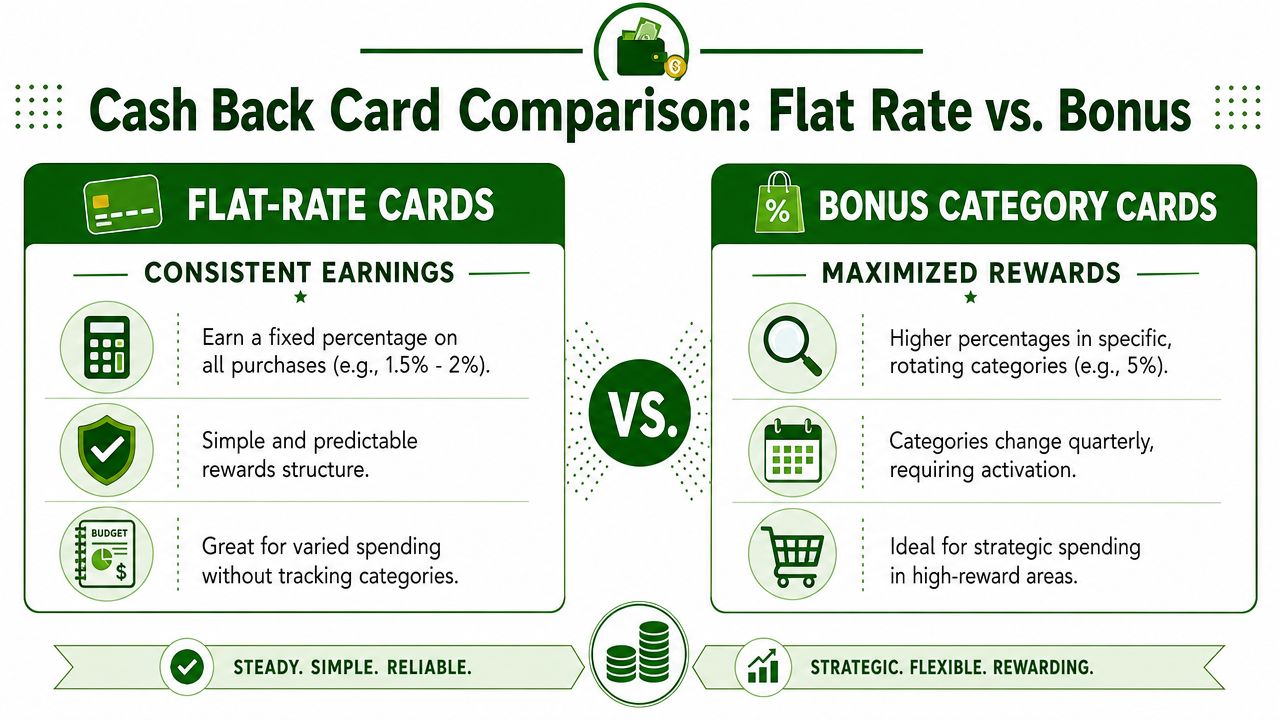
Flat-rate cards win on certainty
Citi Double Cash is a strong benchmark because it offers a straightforward 2% effective return on purchases, structured as 1% when you buy and 1% when you pay off the purchase (benchmark comparison discussing Citi Double Cash and Citi Strata Premier).
That setup is powerful for a simple reason. It reduces mistakes. You don’t need to remember categories, track portals, or decide which card to use at checkout. For households with mixed spending patterns, that simplicity can preserve more value than a theoretically richer rewards table.
Category cards win when your budget is concentrated
The same benchmark comparison shows why Citi Strata Premier can outperform a flat-rate card for the right spender. It carries a $95 annual fee, offers a 60,000-point bonus after $4,000 in spending, gives 10x points on hotels, car rentals, and attractions booked through Citi Travel, and 3x points on air travel, other hotel purchases, restaurants, supermarkets, gas stations, and EV charging.
That’s a richer structure, but it introduces a harder question: are those categories large enough in your monthly budget to offset the annual fee and beat a clean 2% return?
A category card isn’t better because it has more multipliers. It’s better only if those multipliers apply to spending you already do.
A practical break-even mindset
You don’t need a complicated spreadsheet to make the call. You need honest assumptions.
Use this sequence:
- List your biggest categories: dining, groceries, gas, travel, and any recurring area where the card offers higher rewards.
- Compare against a flat 2% baseline: ask whether your likely rewards premium is meaningfully above that baseline.
- Subtract fee drag: any annual fee lowers your net return unless rewards and perks cover it.
- Discount hard-to-use rewards: if redemptions feel cumbersome, lower the value you assign to them.
Which cash back style fits your life
A flat-rate card usually fits if:
- Your spending is broad: you buy across many merchants and categories.
- You want low maintenance: you don’t want to manage a card strategy.
- You value predictability: you’d rather lock in a reliable return than chase upside.
A category card usually fits if:
- Your spending is concentrated: dining, supermarkets, gas, or travel make up a large share.
- You’ll use the card intentionally: you’re comfortable pairing spending categories to the rewards table.
- You can justify the fee: your incremental rewards clear the annual fee with room to spare.
The hidden issue is behavior. Some people overestimate how disciplined they’ll be. If you know you’ll forget category rules or split spending across the wrong cards, the best cash back card may be the one that asks almost nothing from you.
Deep Dive Best Travel and Premium Cards
Premium cards sit in a different category of decision-making. You’re not just buying rewards. You’re buying access, service, flexibility, and in some cases a smoother travel routine.

That’s why issuer reputation matters more here than it does with basic cash back products. J.D. Power’s 2025 U.S. Credit Card Satisfaction Study ranked American Express highest with a score of 643, marking its sixth consecutive year at the top (J.D. Power 2025 U.S. Credit Card Satisfaction Study). In the premium segment, service quality becomes part of the product.
What a high annual fee is really buying
Bankrate’s May 2026 rankings, cited in the verified data, place the Chase Sapphire Reserve at a $795 annual fee with up to 150,000 bonus points, while Chase Freedom Unlimited is listed with $200 cash back. That contrast matters because it captures the split inside the “best credit cards” conversation.
One card asks you to think like a benefits auditor. The other asks whether you want straightforward rewards with far less cost friction.
Premium-card value usually comes from a mix of factors:
- Travel-related benefits: airport experience, credits, protections, and other trip-facing features
- Redemption options: how flexibly points can be used
- Service quality: how the issuer handles disputes, support, and premium account treatment
- Lifestyle fit: whether you travel enough to use any of it
If you’re paying a large annual fee, you should be able to name exactly which recurring benefits justify it. If you can’t, the card is probably aspirational rather than practical.
The audit premium-card users should run
A premium card deserves a stricter review than a cash back card. Ask yourself:
- How often do you travel in a normal year? “Sometimes” isn’t enough.
- Do you book in the ecosystems the card rewards best? Premium value often depends on using preferred channels.
- Will you redeem points efficiently? If points pile up unused, advertised value stays theoretical.
- Do you care about service quality? Premium users often notice support differences more than basic rewards users do.
Here’s a closer visual look at how people evaluate travel-card trade-offs. https://www.youtube.com/embed/7A-e_bP6b6Y
Who should skip premium cards
A premium card is often a poor fit for three groups.
- Occasional travelers: if travel is irregular, benefits are harder to monetize.
- Cash back loyalists: if you prefer clear value over transfer strategies, premium points can feel like work.
- Budget-tight households: a large annual fee creates pressure to “make the card worth it,” which can distort spending decisions.
If a premium card changes your behavior more than it changes your net value, it isn’t a premium product for you. It’s a costly hobby.
Deep Dive Specialized Cards for Goals and Growth
Not every card should be judged on rewards. Some cards are tools for a specific job: managing a temporary balance, establishing a credit profile, or capturing a niche perk that aligns with one recurring expense.
That’s where many “best credit cards” roundups fall short. They compare broad rewards tables and miss the cards that solve a narrower, more important problem.

Cards built for financing and credit building
A 0% APR card can be the right choice when your main goal is paying down a purchase or consolidating existing revolving debt. In that situation, the most valuable feature isn’t the rewards program. It’s the breathing room created by the introductory APR window. The strategy only works, though, if you have a payoff plan before that window ends.
A secured card plays a different role. It’s often the right starting point when you need to build or rebuild credit history. The purpose isn’t optimization. It’s consistency: make small purchases, pay on time, keep usage controlled, and build a record that can support better products later.
Niche perks can beat broad rewards
Independent coverage highlighted by NerdWallet points to an overlooked segment of the market: cards with unusual but practical benefits such as pet injury insurance, pet-spend rewards, waived annual fees tied to account relationships, and reimbursement for TSA PreCheck or Global Entry (NerdWallet’s look at under-the-radar cards with hard-to-find perks).
This matters more than it sounds. A household that spends meaningfully on pets, values a banking relationship benefit, or regularly uses expedited airport screening may get more real value from a card built around that use case than from a generic rewards product with a higher headline earn rate.
Match the card to the mission
Think in terms of financial jobs:
- Paying down debt: prioritize the intro APR and a realistic payment schedule.
- Rebuilding credit: prioritize approval accessibility, reporting, and simplicity.
- Reducing one recurring cost: prioritize the one perk you’ll use.
- Maintaining flexibility: avoid products whose value depends on complicated redemption habits.
The strongest insight here is that specialized cards often work best as problem solvers, not forever cards. You may use a balance-transfer card for a defined period, a secured card until your profile improves, or a niche perk card alongside a primary rewards card.
Application Strategy and Common Questions
A strong application starts before you submit anything. Review your credit profile, understand why you’re applying, and choose one card that matches that purpose. Applying without a clear fit increases the odds that you’ll accept the wrong product even if you’re approved.
If your main issue is financial strain rather than product selection, pause the rewards search. It may be smarter to explore credit card hardship options first and stabilize payments before opening a new account.
How to improve your odds before applying
A few habits help without requiring complicated planning:
- Check your credit report: make sure the information is current and recognizable.
- Match the card to your profile: premium cards, starter cards, and balance-transfer cards solve different problems.
- Avoid forcing the bonus: don’t choose a card whose value depends on spending you wouldn’t normally do.
- Prepare a repayment plan: especially if APR is part of the decision.
For readers who want help comparing multiple cards against their own spending patterns, Kudosz offers a wallet optimization feature that shows available cards and a “dream wallet” after a short questionnaire. Used carefully, tools like that can narrow your options before you apply.
Common questions people still ask
What’s the best first credit card for a student or beginner
Usually, it’s the card that is easiest to manage responsibly. For many first-time users, that means a no-fee starter card or a secured card rather than a rewards-heavy product. The goal at the beginning is to build a clean payment record and learn how to use revolving credit without carrying unnecessary debt.
Should I choose a balance-transfer card or a rewards card
Choose the card that addresses the more urgent problem. If you’re carrying expensive debt, financing terms matter more than rewards. Rewards matter more after the balance is under control.
Is a high annual fee ever worth it
Yes, but only when you can identify recurring benefits and redemption habits that clearly justify the fee. If the value depends on “maybe” travel, “someday” redemptions, or credits you have to force yourself to use, the answer is usually no.
Should a small-business owner get a business card or a personal card
That depends on whether the spending is business-related and whether you want to separate business expenses from household finances. Many owners benefit from the cleaner bookkeeping of a business card, while others prefer the simplicity of one personal setup. The key is to match the product to the way expenses flow.
Good card strategy starts with honesty. Your spending habits matter more than marketing copy.
What if my application is denied
Read the adverse action notice, identify the reason, and fix that issue before applying again. The right response might be waiting, improving your credit profile, reducing existing balances, or choosing a more suitable product rather than immediately trying another issuer.
The best credit cards in 2026 don’t belong to one issuer, one rewards model, or one annual-fee tier. The best one is the card whose effective value survives contact with your real life. That means a flat-rate cash back card for some people, a category card for concentrated spenders, a premium travel card for frequent travelers, or a specialized product for debt payoff, credit building, or one recurring perk you’ll use.
If you want a simple decision rule, use this one: ignore the headline and price the card as if you were the issuer. Count the rewards you’ll earn, subtract the fee, discount perks you won’t use, and treat the sign-up bonus as temporary. The answer is usually clearer than the marketing makes it seem.
* Disclaimer: Kudosz is not a financial advisor and our Top 5 Best-Rated ratings are not financial advice. This information is for educational purposes only and does not constitute financial advice. Doing business with any providers noted is at your own risk.