Your finances can look fine on paper and still feel hard to manage in real life.
Maybe you’ve got a checking account, a brokerage account, an old 401(k), a current 401(k), stock compensation from work, a mortgage, college savings questions, aging parents, and a vague plan to retire “comfortably.” Nothing is broken. But every decision now touches three other decisions. Sell one investment, and taxes matter. Increase savings, and cash flow tightens. Update beneficiaries, and your estate plan suddenly matters too.
That’s usually the point where people start asking a different question. Not “What mutual fund should I buy?” but “Do I need someone to help me coordinate all of this?”
That’s where wealth management advisors come in. Not as stock pickers in fancy suits, but as people who help connect moving parts into one strategy.
When Your Finances Outgrow a Spreadsheet
A spreadsheet works well when your financial life is simple. Income comes in. Bills go out. Retirement contributions happen on schedule. Your goals are straightforward.
Then complexity creeps in.
You change jobs and leave behind an old retirement plan. Your compensation includes stock options or RSUs. A parent names you in their estate documents. You buy a second home or start a business. You suddenly have enough assets that “good enough” decisions can get expensive.
That’s the moment many people confuse success with clarity. You may be earning more than ever and still feel less certain about what to do next.
A wealth management advisor is often most useful at exactly that point. The job isn’t just choosing investments. It’s helping you make connected decisions over time so your tax moves, investment choices, insurance coverage, retirement plan, and estate documents aren’t working against each other.
Practical rule: If one financial decision now creates tax, legal, insurance, and family consequences, you’re no longer dealing with a simple money problem.
This isn’t a fringe profession built for a tiny elite. The U.S. advisory market is large and institutionalized. The SEC reported 21,669 investment advisers in 2024, and those firms oversaw $144.6 trillion in regulatory assets under management according to the SEC’s investment adviser statistics.
That scale matters because it changes how you should think about the role. A wealth manager isn’t a luxury add-on by definition. For many households, business owners, executives, and retirees, it’s a professional service designed to handle complexity that DIY tools don’t fully address.
Signs your finances may have outgrown DIY
- Your accounts are scattered: You’ve got money in several institutions, and no single dashboard tells the whole story.
- Your compensation is uneven: Bonuses, equity grants, or business income make planning harder than a simple salary.
- Your goals are competing: You’re trying to save for retirement, support family, reduce taxes, and stay liquid at the same time.
- You keep postponing decisions: Not because you’re irresponsible, but because each choice feels like it needs expert review.
If that sounds familiar, the question isn’t whether wealth management advisors exist for people like you. It’s whether the cost of staying uncoordinated is starting to exceed the cost of getting help.
What Is a Wealth Management Advisor Really
The cleanest way to think about a wealth management advisor is this. They’re the general contractor for your financial life.
A general contractor doesn’t do every job personally. They coordinate the right specialists, keep the plan coherent, and make sure the plumber doesn’t create a problem for the electrician. Wealth management advisors do the same thing with your money.

If you already have a CPA, estate attorney, insurance agent, and investment accounts, you might assume you’re covered. Sometimes you are. But many people really have separate vendors, not an integrated plan. One person handles taxes. Another manages investments. Nobody is responsible for how the pieces fit.
The four areas they often coordinate
A true wealth manager usually works across several planning lanes at once.
| Area | What it means in practice |
|---|---|
| Investment strategy | Building and monitoring a portfolio that fits your goals, taxes, time horizon, and risk tolerance |
| Tax planning | Looking at account location, gains, withdrawals, charitable giving, and timing decisions with tax consequences |
| Estate planning | Coordinating beneficiary designations, trusts, wills, and transfer goals with your attorney |
| Retirement planning | Turning savings into an income strategy that works before and after you stop working |
That’s why the role feels broader than “investment advisor.” Good wealth management is less about beating a benchmark and more about reducing friction across your financial life.
What this looks like in real life
Consider a business owner who sells a company. The obvious issue is what to do with the proceeds. But that’s only one layer.
They may also need to decide how much cash to hold, when to recognize income, how to update estate documents, how to protect assets, whether to help adult children, and how to replace business income. A coordinated advisor can help sequence those decisions. If that situation sounds familiar, this guide to asset protection for entrepreneurs adds useful context around the legal and planning side.
Wealth management works best when one person or team can see the whole chessboard.
Is this for you
You’re more likely to benefit from a wealth management advisor if you want ongoing guidance, not a one-time plan.
You may also be a good fit if your personality leans toward delegation with oversight. Some people enjoy managing every account and reading every prospectus. Others want a professional to organize the work while they stay involved at a higher level. Neither approach is wrong. The better choice is the one you’ll maintain.
If you mainly want help opening an IRA or picking a basic portfolio, a wealth manager may be more service than you need. If you want one person to connect taxes, investments, retirement, and family planning, the role starts to make more sense.
Decoding Advisor Credentials and Firm Types
Financial credentials can feel like airport codes. CFP, CFA, RIA, BD. You don’t need to memorize the alphabet soup. You just need to know what each label changes for you as a client.
Credentials tell you where the person leans
A CFP professional usually signals broad planning training. That often matters when your questions involve retirement, insurance, education funding, cash flow, and estate coordination, not just investing.
A CFA charterholder usually signals deeper investment analysis. That can matter if portfolio construction, manager selection, or securities analysis is central to the relationship.
Neither label guarantees a great fit. A brilliant planner can still be a poor communicator. An investment expert can still ignore the bigger picture. Credentials are a filter, not a final answer.
Firm type matters as much as the person
The structure of the firm affects how advice is delivered and how the advisor gets paid.
An RIA, or Registered Investment Advisor, is generally associated with ongoing advisory relationships and a fiduciary obligation in that advisory capacity. A broker-dealer model has historically centered more on securities transactions and product distribution. In practice, some firms operate in ways that blur those lines for clients, which is why you should ask direct questions instead of assuming the business card tells the whole story.
Here’s the core idea.
What you want to hear: “I’m acting as a fiduciary for you, and I can explain when that standard applies.”
A fiduciary standard means the advisor is legally obligated to act in your best interest in that role. That doesn’t mean every fiduciary is equally skilled, and it doesn’t mean non-fiduciary professionals can’t be helpful. It does mean the legal duty is stronger and usually easier for clients to understand.
Questions worth asking in the first meeting
- Are you a fiduciary at all times, or only in certain engagements? This tells you whether the standard applies consistently.
- How are you compensated? If the answer is muddy, keep digging.
- Who holds my assets? The advisor may manage the relationship, while a separate custodian holds the money.
- What services are included beyond investing? Some advisors say “wealth management” when they really mean portfolio management plus occasional check-ins.
If you’re comparing large institutions with smaller firms, it can help to review how different financial providers are structured. This roundup of top-rated banks is useful for understanding how consumers compare financial firms on service model, account structure, and practical features.
What confused clients often miss
People often spend too much time on titles and not enough time on fit.
A strong advisor should be able to explain their role in plain English, describe how decisions get made, and tell you where they stop. If someone hides behind credentials, jargon, or polished marketing, that’s not sophistication. That’s a communication problem.
The ideal answer is often simple. Find a clear communicator, understand the firm’s legal structure, and confirm whether fiduciary advice applies to your relationship.
Wealth Manager vs Financial Planner vs Robo-Advisor
These three options solve different problems. They overlap, but they aren’t interchangeable.
Advisor role comparison
| Criterion | Wealth Management Advisor | Financial Planner | Robo-Advisor |
|---|---|---|---|
| Scope of service | Ongoing, integrated management across investments, taxes, retirement, estate coordination, and other planning needs | Usually centered on creating a financial plan around goals like retirement, college, or cash flow | Automated portfolio management based on your inputs |
| Typical client | Someone with multiple moving parts, higher complexity, or a need for ongoing coordination | Someone who wants a roadmap, second opinion, or targeted advice on a planning issue | Someone who wants low-maintenance investing and basic allocation help |
| Cost or fee structure | Often ongoing advisory pricing tied to an ongoing relationship | Often project-based, hourly, retainer, or limited-scope advisory pricing | Typically platform-based pricing built into the account experience |
| Level of personalization | High, especially when life events and outside professionals must be coordinated | Moderate to high, depending on scope of engagement | Lower, though still useful for straightforward needs |
The easiest way to choose is to ask what problem you’re trying to solve.
When a robo-advisor makes sense
A robo-advisor is often enough if your main need is automated investing. You answer questions about your timeline and risk tolerance, the platform recommends a diversified portfolio, and software handles rebalancing and account maintenance.
That can be a very good solution for someone early in their investing life, or for someone who wants disciplined, low-effort investing without an ongoing human relationship.
A robo-advisor is usually less useful when your issues spill beyond asset allocation. It won’t sit with you and weigh whether to exercise stock options this year, how to coordinate an inheritance, or how to restructure spending before retirement.
When a financial planner is enough
A financial planner is often the right middle option.
Suppose you want to know whether you can retire in your early sixties, how much to save for a child’s education, or how to balance debt repayment against investing. A planner can build models, test scenarios, and help you make a decision without necessarily taking over your whole financial life.
That works especially well if you’re capable of implementing the advice yourself and mostly need judgment, not ongoing management.
A plan answers, “What should I do?” Ongoing wealth management also answers, “Who’s making sure it all stays coordinated next year, and the year after that?”
When you likely need a wealth manager
A wealth manager becomes more relevant when complexity stacks up.
Examples include a recent business sale, executive compensation, trust planning, cross-account tax issues, family wealth transfers, concentrated stock positions, or a retirement strategy that depends on sequencing withdrawals from different account types. In those cases, the investment portfolio is only one piece of the puzzle.
A simple self-diagnosis
You probably lean toward a robo-advisor if you want convenience, low touch, and mostly need investing automation.
You likely lean toward a financial planner if you want a roadmap for a specific goal but are comfortable carrying it out yourself.
You may need a wealth management advisor if your financial life feels like a set of interlocking decisions and you want an ongoing professional relationship to coordinate them.
The right option isn’t the most impressive one. It’s the one that matches your complexity, your budget, and how involved you want to be.
Understanding How You Pay for Financial Advice
Fees confuse people because they’re often described in industry language instead of everyday language. The simplest way to evaluate pricing is to ask two questions. How is the advisor paid, and what behavior does that payment structure encourage?
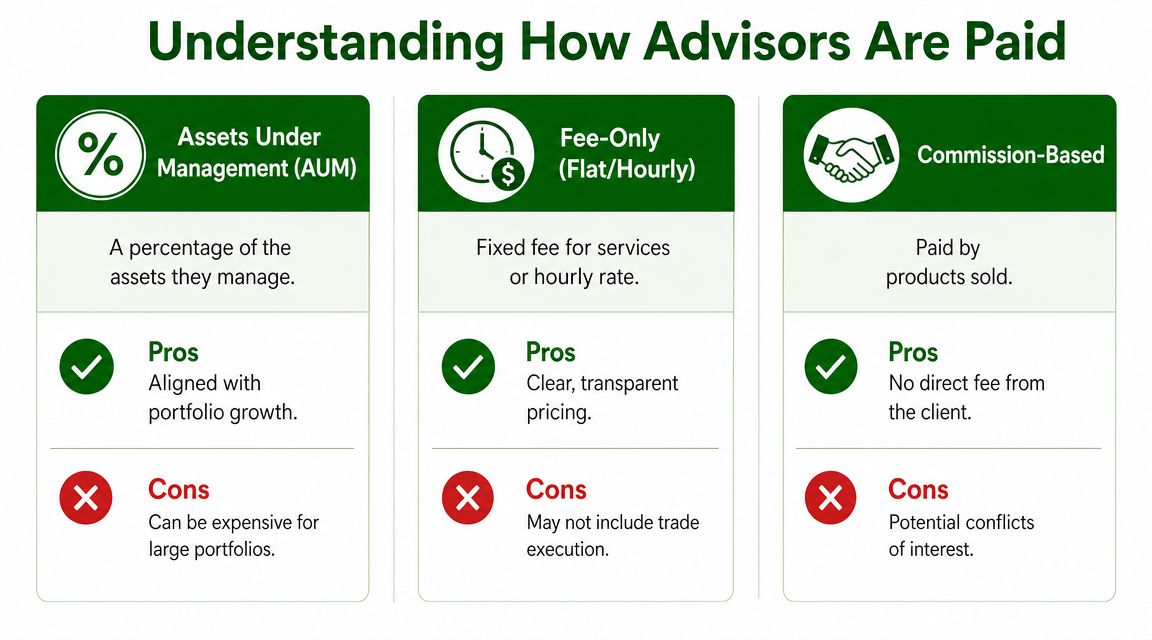
The three common models
Assets under management means the advisor charges a fee tied to the assets they manage for you. This resembles an ongoing management subscription. If the relationship includes portfolio oversight, regular meetings, rebalancing, and broad planning support, this model can feel straightforward.
The tradeoff is that clients with larger portfolios may pay materially more even if their service needs don’t rise in lockstep. It may also create a subtle incentive to keep assets under the advisor’s management rather than directing money elsewhere.
Fee-only planning usually means you pay directly for advice through a flat project fee, hourly rate, or retainer. That can work well if you want a plan, a second opinion, or targeted help without handing over investment management.
The strength of this model is transparency. The possible downside is scope. Some engagements produce recommendations, but you still have to implement them yourself.
Commission-based compensation means the advisor is paid when you buy certain financial products. That can reduce or eliminate direct out-of-pocket advisory fees from your perspective, at least on the surface.
The concern is obvious. Product compensation can create conflicts if an advisor has a reason to recommend one solution over another.
Don’t ask only what it costs
Ask what’s included, what isn’t, and what the advisor is incented to do.
A person who needs ongoing coordination may get good value from an ongoing fee. Someone with a simpler situation may overpay for services they won’t use. On the other hand, a cheap arrangement can be expensive if it leads to poor product choices or no follow-through.
The right fee model is the one that matches the kind of help you need and lets you understand the advisor’s incentives without guesswork.
A practical way to compare offers
When you interview advisors, ask for these items in plain language:
- What services are covered: Investment management, retirement planning, tax coordination, estate review, meetings, and ongoing availability.
- What triggers extra cost: Special projects, trust work, business planning, or detailed tax analysis.
- How implementation works: Whether they only advise, or also execute trades and account changes.
- How conflicts are managed: Especially if products, insurance, or outside compensation are involved.
A clear answer is often more important than a low headline fee. People get into trouble when they compare prices without comparing incentives, scope, and accountability.
Do You Actually Need a Wealth Management Advisor
A lot of people assume wealth management advisors are only for families with old money, private foundations, and a household office. That picture is outdated.

The industry is widening beyond the classic high-net-worth mold. Commentary highlighted by InvestmentNews on underserved advisory markets points to a growing focus on overlooked client segments and on needs that are often more practical than theoretical, such as budgeting, debt, emergency savings, and cash-flow decisions.
That matters because “Is this for me?” isn’t only an asset question. It’s also a complexity question, a behavior question, and sometimes a life-stage question.
You may need one if your life has become financially layered
Some triggers are obvious. You sold a business. You inherited money. You’re managing concentrated stock from your employer. You’re approaching retirement with multiple account types and need a withdrawal strategy.
Other triggers are quieter.
You may need help if you and your partner handle money very differently. Or if your finances are technically solid but emotionally neglected because no one wants to make the next decision. Or if your family situation creates obligations that spreadsheets don’t capture well.
A quick self-check
You’re more likely to benefit from a wealth management advisor if several of these sound true:
- Your money decisions affect more than investing: Taxes, family support, estate wishes, or business interests all interact.
- You want coordination, not just recommendations: You don’t just want a report. You want someone to help keep the plan moving.
- You dislike administrative drag: Consolidating accounts, reviewing beneficiaries, and tracking follow-up keeps slipping.
- Your situation doesn’t fit a generic template: You need advice specific to a career path, family structure, or liquidity event that’s unusual.
Some people also need a specialist rather than a generalist. A physician, founder, executive, widow, newly divorced client, or blended family may benefit from an advisor who already understands the patterns and blind spots common in that niche.
A short video can help frame that decision in plain language.
You may not need one yet
You probably don’t need full wealth management if your finances are still straightforward, you enjoy handling them, and you consistently follow through.
In that case, a planner, tax professional, or even a solid digital platform may cover most of what you need. Some people use personal finance dashboards and planning tools to track net worth, review fees, and model long-term goals before they ever hire an advisor. The key is honesty. Are your finances simple, or are they just unmanaged?
The best reason to hire an advisor isn’t status. It’s that the right relationship helps you make better decisions with less friction.
How to Hire the Right Advisor and Avoid Red Flags
Hiring an advisor is less like buying a product and more like choosing a long-term doctor, attorney, or business partner. Skill matters, but so do temperament, clarity, and trust.
McKinsey projects that by 2034 the U.S. wealth management industry could face a shortage of 90,000 to 110,000 advisors, or roughly 30% to 37% of current headcount, while about 110,000 advisors may retire in the next decade according to McKinsey’s analysis of the advisor shortage. That makes your search more important. Good advisors may become harder to find, and a strong fit is worth securing early.
Questions to ask before you sign
- How do you define success for clients like me? You want an answer broader than investment returns alone.
- What does communication look like during a normal year? Some clients want structure. Others want flexibility.
- Who will I work with? In many firms, the person in the meeting isn’t the only person touching your account.
- What kinds of clients are not a fit for your firm? This often reveals more honesty than a polished pitch.
If you want a practical outside checklist, these expert tips for finding an advisor are a useful complement to your interview questions. It can also help to compare how financial firms present service, regulation, and account structure in resources like this guide to banking and personal finance firms.
Red flags that should slow you down
- Guaranteed returns: Serious professionals don’t promise certainty in markets.
- Pressure to act quickly: Urgency is often a sales tactic, not a planning necessity.
- Vague fee explanations: If you can’t explain how they get paid, don’t proceed.
- One-size-fits-all advice: Your finances deserve more than a canned model portfolio and generic retirement script.
The right advisor should leave you feeling informed, not cornered. If you can understand how they think, how they’re paid, and how they’ll work with you, you’re already ahead of many beginning this search.
* Disclaimer: Kudosz is not a financial advisor and our Top 5 Best-Rated ratings are not financial advice. This information is for educational purposes only and does not constitute financial advice. Doing business with any providers noted is at your own risk.