You’re probably in one of two places right now. You’re planning a trip and the total keeps climbing, or you keep hearing people talk about “using points for travel” and you’re wondering whether travel reward credit cards are useful for a normal person.
That’s the right question.
A lot of travel card advice is aimed at frequent flyers who know airport lounges, transfer partners, and every airline alliance by heart. However, many don’t live like that. They want something simpler. They want to know whether regular spending can make one vacation cheaper, whether the annual fee is justified, and whether they’d be better off with plain cash back.
Travel reward credit cards can be valuable. They can also be overrated for the wrong person. The difference usually comes down to how you spend, how you book travel, and whether you’ll use the perks you’re paying for.
What Are Travel Reward Credit Cards
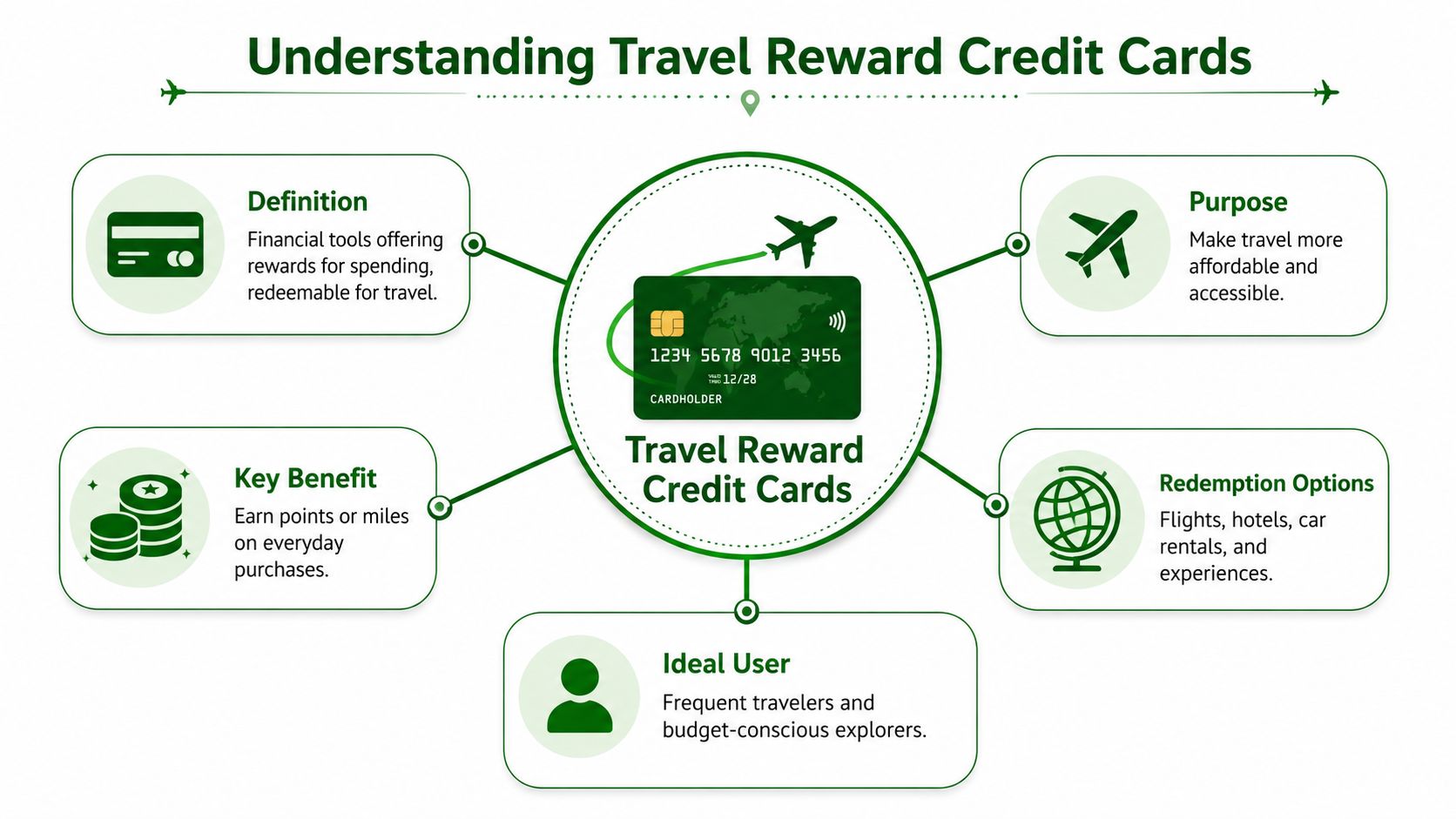
A travel rewards card turns everyday purchases into points or miles you can later use for travel.
That sounds simple, but the part that trips people up is the currency itself. Cash back is dollars. Travel rewards are a separate currency with rules attached. You earn them from spending now, then use them later for flights, hotels, rental cars, or eligible travel charges, depending on the card.
What makes them different
Most travel reward cards use a points or miles system instead of paying you back in plain cash. A common setup is a base earning rate on everyday spending, with higher rates on travel or dining purchases. That structure helped push these cards into the mainstream. Spherical Insights estimates the global travel credit card market was worth USD 18.34 billion in 2023 and could reach USD 57.10 billion by 2033, with a projected 12.03% CAGR.
The practical difference is not just how you earn. It is how much those rewards are worth when you use them.
A cash-back card is straightforward. Spend $100, get a set percentage back. A travel card can be more valuable, but only if you redeem well. One point is not always worth one cent, and the value can change depending on whether you book through the card issuer, transfer to a travel partner, or cash out at a lower rate. That is why travel cards can feel confusing at first. The earning side is easy. The value side takes a little math.
Why people pay attention to them
Travel cards get attention because they can do more than trim a statement balance:
- Everyday spending can help fund a trip. You may earn rewards from groceries, gas, dining, and regular bills, not just airfare.
- Travel redemptions can outvalue cash back. In some cases, the same spending produces more usable travel value than a flat-rate cash-back card.
- Perks can reduce real trip costs. Features like no foreign transaction fees, trip protections, or hotel and airline benefits can save money if you use them.
- Welcome offers can create a fast head start. A sign-up bonus is often the biggest early source of value.
Here is the key filter: a travel card works best when it matches trips you would take anyway. If you need a card to be simple, predictable, and easy to value, cash back may still be the better tool.
That is the angle many articles skip. Travel rewards are not automatically better. They are only better when the points, perks, and annual fee add up to more real-world value for your habits than a simpler alternative.
If you like seeing how card choices fit into the bigger money picture, Kudosz also publishes broader reading on banking and personal finance firms.
General Travel Cards vs Co-Branded Cards
Your first real choice isn’t about annual fee or points logo. It’s about flexibility versus loyalty.
A general travel card is like a universal gift card. A co-branded airline or hotel card is like a store gift card. Both can be useful. The better one depends on how fixed your travel habits are.
The basic split
General travel reward cards usually earn points in a bank or issuer program. You might redeem through a travel portal or transfer points to airline and hotel partners, depending on the card.
Co-branded cards are tied to one airline or one hotel group. You earn that brand’s miles or points, and the perks are usually strongest when you stay loyal to that brand.
General Travel Cards vs. Co-Branded Cards
| Feature | General Travel Reward Cards | Co-Branded Airline/Hotel Cards |
|---|---|---|
| Primary value | Flexibility across many travel options | Better fit for one airline or hotel chain |
| Rewards currency | Issuer points | Airline miles or hotel points |
| Best for | Travelers who compare prices and book different brands | Travelers who repeatedly use the same brand |
| Redemption style | Travel portals, statement credits, sometimes partner transfers | Usually the brand’s own flights, rooms, upgrades, or brand perks |
| Perk structure | Broad travel protections and category bonuses | Brand-specific benefits such as baggage, boarding, or status-related features |
| Risk | Can be more complex to learn | Less flexible if prices or routes don’t fit your trip |
When a general card makes more sense
A general card is often the easier starting point for an average spender. If you fly different airlines depending on price, or you book whichever hotel works for your trip, flexibility matters.
This type of card also works better if your travel isn’t predictable. You’re not stuck earning a currency that only shines with one brand.
When a co-branded card can win
Co-branded cards work best when your habits are already set. Maybe your home airport is dominated by one airline. Maybe your family always stays with one hotel chain because the locations are convenient.
In those cases, brand perks can matter as much as points. That’s especially true if the card helps smooth the trip itself, not just reduce the bill.
The right card isn’t the one with the flashiest ad. It’s the one that matches how you already travel.
A practical way to choose
Ask yourself three questions:
- Do I usually choose based on price or brand loyalty?
- Would I use brand-specific perks?
- Do I want simple redemptions or more options later?
If you mostly shop around, start with general travel reward credit cards. If you repeatedly fly or stay with the same company, co-branded cards deserve a serious look.
How You Earn Points and Miles
Earning rewards is where many people get lost, mostly because card marketing throws a lot of numbers at you. The cleanest way to understand it is to think of points earning like filling a bucket.
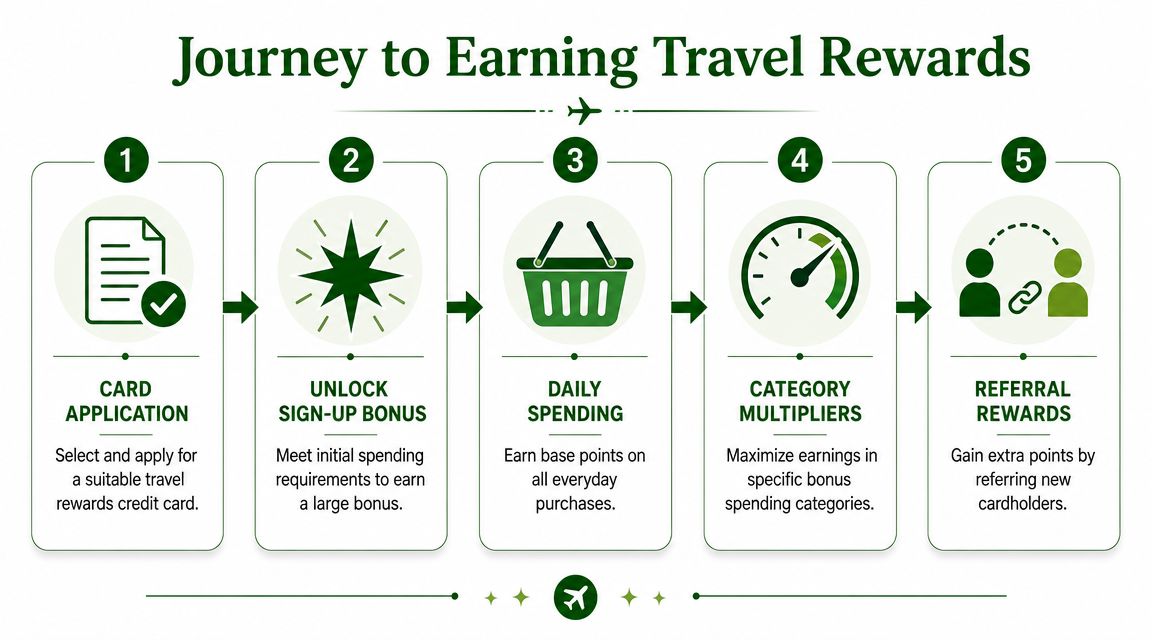
The sign-up bonus is the big splash. Everyday spending is the steady stream. Bonus categories are the faster faucet.
Sign-up bonuses do the heavy lifting
Many travel cards put the biggest value up front. A commonly advertised U.S. offer highlighted by Airlines for America gives 25,000 bonus points after $1,000 in purchases within 90 days, worth about $250 in travel statement credit, along with ongoing earning of 1.5 points per $1 and no annual fee on some products, according to Airlines for America.
That’s why people say welcome offers matter so much. It can take a long time for routine spending alone to match the value of a solid bonus.
Category multipliers change the math
Not all purchases earn at the same rate. Some cards pay a base rate on most spending, then add multipliers for certain categories.
For example, First Tech’s Odyssey Rewards card details show how one structure offers 3x points on travel and hotels with no foreign transaction fees, while another well-known structure can earn 5x on travel purchased through an issuer portal, 2x on other travel, and 3x on dining and select groceries. The important lesson is simple: where you book and how the purchase is coded can change what you earn.
Here’s the part that confuses people. A hotel booked directly with the hotel may earn differently than a trip booked through a card issuer’s portal. Two travel purchases can look similar to you but be treated differently by the card.
A simple earning framework
Use this checklist before you swipe:
- Start with the bonus: Only apply if you can meet the spending requirement through normal purchases.
- Know your top categories: Dining, groceries, gas, and travel often matter more than rare purchases.
- Check booking channels: Portal bookings may earn more, but flexibility may be lower.
- Keep one default card in mind: If you have multiple cards, know which one handles “everything else.”
Practical rule: Don’t change your spending to fit a card. Choose a card that fits spending you already do.
Referral rewards and shopping portals can also add points, but they’re extras. Typically, the primary engine is still welcome bonus plus category spending.
Redeeming Rewards for Maximum Value
Earning points feels good. Redeeming them well is what determines whether the card was worth it.

A useful analogy is foreign currency exchange. One redemption option is like changing money at the airport kiosk. Easy, but not always the best rate. Another is like finding a better exchange route that gets you more buying power.
The common redemption paths
Most travel cards give you a few choices:
- Book through the card issuer’s travel portal
- Transfer points to airline or hotel partners
- Redeem for cash back or statement credit
- Use points for gift cards or non-travel purchases
These options are not equal.
According to NerdWallet’s travel card guidance, general travel card points often have a fixed value around 1 to 1.5 cents per point, and points from transferable programs like Chase Ultimate Rewards, Amex Membership Rewards, and Capital One Miles often produce the strongest value when moved to airline or hotel partners rather than redeemed as plain cash back.
Why partner transfers can matter
Transferable points are popular because they give you choices later. You don’t have to decide at the moment you earn them whether they’ll become a flight, a hotel stay, or a portal booking.
That flexibility can be especially useful if you’re trying to find affordable business class without paying full cash prices. Even if you’re not chasing luxury seats, the same idea applies to economy flights and hotel stays. The best redemption often depends on the trip, not just the card.
Convenience versus value
Cash back is simple. Travel redemptions can be more rewarding but require more comparison.
That doesn’t mean everyone should transfer points. If you hate searching award availability or learning partner systems, a straightforward portal redemption may be the better choice for you even if it isn’t mathematically perfect.
A short explainer can help if this part still feels abstract:
Don’t ask, “How many points do I have?” Ask, “What trip can these points actually cover?”
A smart redemption habit
Before you cash out points, compare at least two options. Check the issuer portal. Then check whether a transfer partner would serve the same trip better. If the extra value is tiny, take the simple route. If the gap is meaningful and the booking is reliable, transferring may be worth the effort.
Weighing the Pros, Cons, and Common Fees
A travel card can save you money. It can also become an expensive coupon book if you pay for perks you never use.
That is the right frame for this section. Travel rewards are not automatically better than cash back. They are a tool, and the value depends on whether the tool fits your habits.
Why travel cards can be worthwhile
For the right cardholder, the upside is pretty straightforward. You spend on things you would buy anyway, earn rewards, and use those rewards to lower the cost of a real trip.
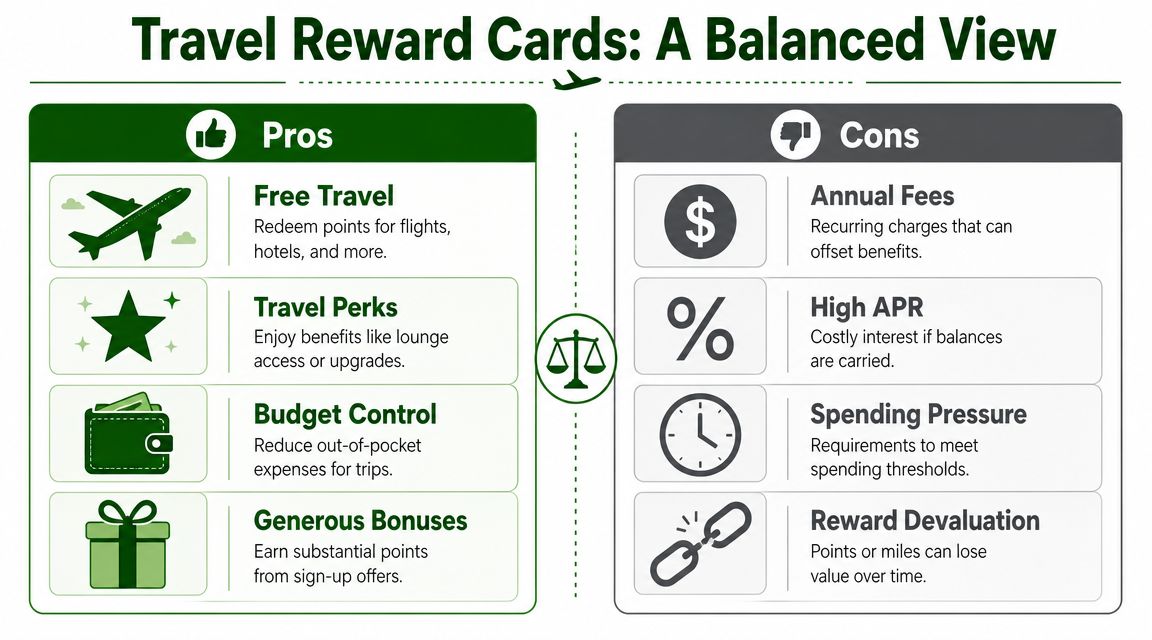
The best benefits usually fall into four practical categories:
- Lower travel costs: Points or miles can cover part of a flight, hotel stay, or rental car.
- Useful protections: Some cards include trip delay coverage, rental car protection, or baggage-related coverage.
- Better earnings on travel or dining: That matters if those categories already make up a meaningful part of your budget.
- Foreign transaction savings: Many travel cards skip these fees, which can help on international trips.
A good travel card works like a membership you use. If the rewards match your spending and the perks fit your trips, the card can pay for itself.
If you want a broader look at programs before comparing specific cards, this strategic travel rewards guide can help you see how card rewards fit into the larger travel ecosystem.
Where the math breaks down
The problem is rarely the headline offer. The problem is the follow-through.
A premium card may advertise lounge access, hotel credits, travel credits, bonus categories, and transfer options. But each perk only has value if you would have used it anyway. A $100 hotel credit is not worth $100 to someone who books one budget stay a year and never chooses the qualifying property.
That is why average travelers should calculate value in plain dollars, not in marketing language. Add up the rewards and credits you expect to use in a normal year. Then subtract the annual fee. If the result is small, a cash-back card may be the cleaner choice.
Common downsides to watch for
Here is where travel cards can disappoint:
- Annual fees: These create the hurdle you have to clear before the card starts helping you.
- Interest charges: Carrying a balance can wipe out the value of rewards fast.
- Complex rules: Bonus categories, issuer portals, partner transfers, and benefit terms all take attention.
- Perk mismatch: Airport lounge access sounds appealing, but it has little real value if you fly once or twice a year.
- Behavior creep: Some cardholders spend more just to justify the card, which defeats the purpose.
This last point confuses people. Saving money with rewards only works if the card fits spending you already planned to do.
Premium cards often depend on credits
Many higher-fee cards now rely on statement credits, issuer travel portals, and brand-specific perks to justify their price. As discussed in Camels & Chocolate’s travel card roundup, current premium card offers often make the value equation more conditional than it first appears.
That matters because a card can look generous on paper and still feel disappointing in real life. If you need to remember five separate credits, book through one portal, and change your travel habits to break even, the card may be more work than it is worth.
Fees and costs that deserve a closer look
A simple checklist helps here:
| Fee or cost | Why it matters |
|---|---|
| Annual fee | This is the upfront cost of keeping the card. Your rewards and perks should clearly exceed it. |
| Interest charges | Travel rewards usually make sense only if you pay your statement in full. |
| Foreign transaction fees | These can quietly raise the cost of using the card abroad. |
| Redemption restrictions | A reward is less valuable if it works only through a limited portal or brand ecosystem. |
| Opportunity cost | A simpler cash-back card may produce similar value with less effort. |
One more practical tip. Compare cards from issuers with terms and service experience you are comfortable with, not just the flashiest bonus. A quick review of top-rated banks for credit cards and everyday banking can give you useful context before you commit.
The bottom line is simple. Travel cards are strongest when you travel enough to use the perks, pay in full, and prefer rewards for trips over pure simplicity. If those conditions do not describe you, cash back is not the boring choice. It may be the smarter one.
How to Choose the Right Card for You
A travel card should fit into your life the way a good suitcase fits a trip. If it carries what you need without adding hassle, it helps. If it is bulky, expensive, and hard to use, a simpler option may serve you better.
For average spenders, the useful question is which card fits your habits, budget, and travel patterns. In many cases, the right answer is a travel card. In others, a cash-back card wins because the value is easier to get and easier to use.
Start with three personal questions
Before comparing welcome bonuses or airport perks, ask yourself:
- How often do I travel in a typical year?
- Do I want flexible rewards, or do I keep booking the same airline or hotel brand?
- Will I use the card’s credits and perks as part of my normal routine?
That third question matters more than many people expect. A card credit is only valuable if you would have made that purchase anyway. If you have to change your behavior to justify the annual fee, the card may be choosing you more than you are choosing it.
Three common traveler types
The occasional vacationer
You take a few trips a year, usually for leisure, and you care more about straightforward savings than squeezing every last cent from a points chart.
A no-fee or low-fee general travel card often works well here. It gives you flexibility without turning rewards into a side project. If the math starts feeling like homework, compare it with cash back. That is your real alternative, not zero rewards.
The frequent business traveler
You book travel often, value convenience, and can use benefits like lounge access, free checked bags, or hotel status because you are already on the road.
A premium general travel card or a co-branded airline or hotel card can make sense if those perks line up with trips you already take. The key is that the card supports an existing pattern instead of asking you to build a new one.
The family traveler
You are usually balancing schedules, baggage, seat selection, and the cost of putting several people on the same itinerary.
A general travel card can be a strong fit if you want the freedom to choose the best flight or hotel each time. A co-branded card can work if your family repeatedly flies one airline or stays with one hotel chain and the perks reduce costs you run into again and again.
Use a break-even mindset
You do not need a spreadsheet worthy of an accountant. A simple comparison is enough:
- What the card costs each year
- What rewards and perks you will realistically use
- What a simpler cash-back card would have earned on the same spending
That framework keeps the decision grounded in real-world value. Travel rewards can look exciting because points feel less concrete than cash. But points are still a form of currency. If a travel card gives you more complexity without clearly giving you more usable value, the simpler card may be the smarter pick.
If you want more perspective on how reward programs differ, this strategic travel rewards guide offers a helpful comparison. If you are also weighing the issuer behind the card, this review of top-rated banks for credit cards and everyday banking can add useful context.
Tools can help if you already have multiple cards and want help keeping rewards straight. For example, some tools, including Kudos, show card benefits and reward rates across cards so you can match purchases to the right one without relying on memory.
If a card only works on paper, it is probably the wrong card for your wallet.
Frequently Asked Questions About Travel Cards
Will applying for a travel card hurt my credit?
Usually a little, at least at first. A card application often triggers a hard inquiry, which can cause a small temporary drop in your score.
What matters more is what you do after the account opens. If you pay on time, keep balances low, and avoid applying for several cards in a short period, your credit can recover well. If you plan to apply for a mortgage or car loan soon, waiting on a new travel card is often the safer move.
Do travel points and miles expire?
Sometimes. The rules depend on the card issuer and the airline or hotel program tied to the rewards.
Some programs keep points alive as long as your account stays open. Others require some activity every so often, such as earning or using points. Travel rewards work a bit like store credit with an expiration policy. The value is only yours if you use it before the deadline. Check the terms before you collect a large balance and assume it will sit there forever.
Are no-annual-fee travel cards worth it?
For many casual travelers, yes.
They are a good training ground. You can learn how earning and redeeming works without feeling pressure to justify a yearly fee. That makes them a sensible first step if you take a few trips a year and want to keep your rewards setup simple.
The tradeoff is straightforward. No-fee cards usually give fewer travel perks, lower reward rates in some categories, and less flexibility than premium cards.
Is cash back better than travel rewards?
Sometimes cash back is the better answer, and that is not a failure. It is often the more practical choice.
Cash back is simple. A dollar is a dollar, and you do not need to learn airline charts or compare redemption options. Travel rewards can beat cash back if you travel regularly and use the points in ways that save real money on trips you were already going to take. If your travel is occasional, your spending is modest, or you prefer straightforward rewards, a cash-back card may give you more usable value with less effort.
A helpful test is this: if you would not book the trip without the points, the reward may be encouraging extra spending instead of saving money.
Do I need to travel often for a travel card to make sense?
No, but you do need a realistic use for the rewards.
A travel card can still fit someone who takes one or two meaningful trips a year, especially if the card offers flexible points, useful protections, or credits that match expenses you already have. But if your rewards sit unused, or if the annual fee is higher than the value you get back, the card is probably not earning its place in your wallet.
That is why a simple cash-back card often wins for occasional travelers. The best card is not the one with the fanciest perks. It is the one you will use well, without changing your habits just to justify it.
Travel reward credit cards can be useful tools. They can also become expensive clutter. The smartest choice is the card that fits your real travel life, your spending, and your tolerance for complexity.
* Disclaimer: Kudosz is not a financial advisor and our Top 5 Best-Rated ratings are not financial advice. This information is for educational purposes only and does not constitute financial advice. Doing business with any providers noted is at your own risk.