Gift shopping tends to arrive in clusters. A birthday this week, a baby shower next month, client thank-you boxes before quarter-end, employee appreciation gifts before the holidays. The spending often feels fragmented, but your card issuer sees something simpler: a steady stream of transactions that can earn rewards.
That matters more than most gift buyers realize. If you already spend on curated baskets, gift cards, celebration sets, and corporate gifting, you don’t need a radically different budget to get more value. You need a better system for where those purchases land.
Most Credit Cards & Rewards advice is built around airfare and hotel stays. That leaves out a common real-world use case: people who buy gifts regularly and want practical returns. Sometimes that means cash back to offset the next round of birthdays. Sometimes it means points that can later cover travel. Sometimes it means using a large planned order to trigger a welcome bonus you were going to earn anyway.
Turn Your Gift Shopping Into a Rewards Engine
A familiar example: you remember three birthdays at once, add a sympathy basket for a colleague, then realize your company still hasn’t ordered employee thank-you gifts. By the time the receipts hit your inbox, gift buying looks like a blur of necessary spending.
Seen another way, it’s one of the cleaner categories to optimize.
Gift purchases are often planned, budgeted, and emotionally unavoidable. You were going to buy the present anyway. That makes them ideal for rewards strategy because the best rewards come from spending you already intended to do, not from inventing purchases to chase points.
A parent buying a themed birthday set, a manager sending onboarding gifts, and a founder mailing holiday baskets to clients all face the same underlying question: what should this spending buy me beyond the gift itself?
For many readers, the answer starts small. A gift basket bought for a friend’s celebration might earn cash back that reduces next month’s spending. If you’re browsing ideas like a birthday gift basket for a milestone celebration, the item itself is only half the decision. The payment method can determine whether that purchase becomes just another expense or part of a repeatable rewards habit.
Gift buyers have one advantage over casual shoppers. They usually know the occasion, the budget range, and the timing window. That makes it easier to match each purchase to the right card, the right redemption path, and the right moment to use a bonus category or welcome offer.
Practical rule: Rewards work best when gifting is intentional. If the purchase was already in your plan, rewards are an upgrade. If rewards cause the purchase, they’re a trap.
How Credit Card Reward Programs Actually Work
Credit card rewards can look like free money, but they work more like a private currency system run by banks. You spend dollars. The issuer gives you points, miles, or cash back according to rules it wrote. Then it lets you redeem that currency inside channels it controls.
That sounds abstract until you reduce it to a simple loop.
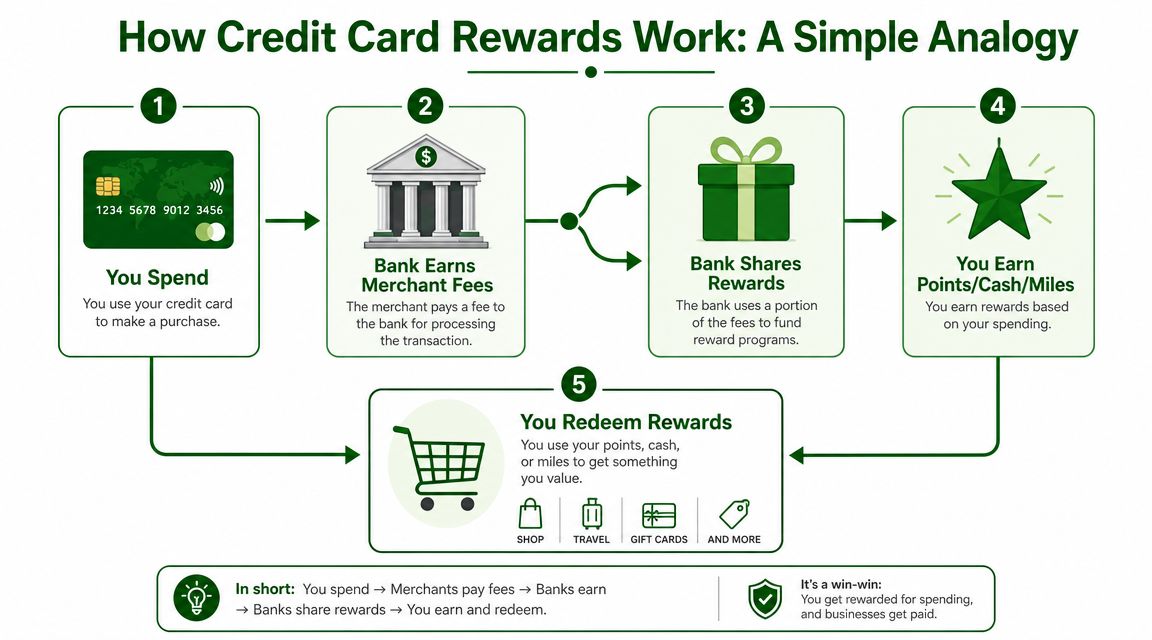
The rewards cycle in plain English
When you buy a gift basket, gourmet box, or merchant gift card with a credit card, the bank earns merchant fees from that transaction. It uses part of that economics to fund rewards. In exchange, you keep using the card.
Rewards aren’t niche anymore. The Consumer Bankers Association says consumers can choose among approximately 4,000 issuers, and about 70% of cards in the CFPB’s Terms of Credit Card Plans Survey database offer rewards. The same source says nearly 4 out of every 10 dollars of rewards earned come from direct cash-back programs, which shows how broad the market has become beyond airline-style redemptions (Consumer Bankers Association summary of CFPB rewards data).
For gift buyers, that mainstreaming matters because you don’t need a premium travel identity to participate. A simple cash-back card can be a rewards card. A category card can be a rewards card. A business card used for employee gifting can be a rewards card.
Why some cards feel generous and others don’t
Issuers design cards around behavior. One card rewards broad everyday spending. Another concentrates value in a narrow category. Another uses a large upfront bonus to attract a new customer who’s likely to keep using the card.
That’s why the same gift purchase can earn very different value depending on which card you use.
If you want to see your own spending patterns before optimizing, tools that sort charges by merchant and category can help. Something like ReceiptsAI financial automation tools is useful because it turns a messy statement into actual spending clusters, which is often the fastest way to notice that gifts, online retail, or employee appreciation purchases are bigger line items than you thought.
A second useful mindset is to separate the payment product from the redemption product. The card decides how you earn. The rewards program decides how much those rewards are worth later.
A points program is less like a rebate and more like store credit issued by a bank. You earn it in one place and discover its real value only when you try to spend it.
That distinction helps explain why discussions about banking and personal finance firms often blur product categories. The credit product, rewards currency, and redemption system may sit under the same brand, but they solve different problems.
Decoding the Rewards Menu Cashback Points and Miles
Gift buyers usually face three reward languages: cashback, points, and miles. They’re not interchangeable, even when marketing makes them sound similar. The right choice depends less on the card’s branding and more on what you want your gift spending to produce later.
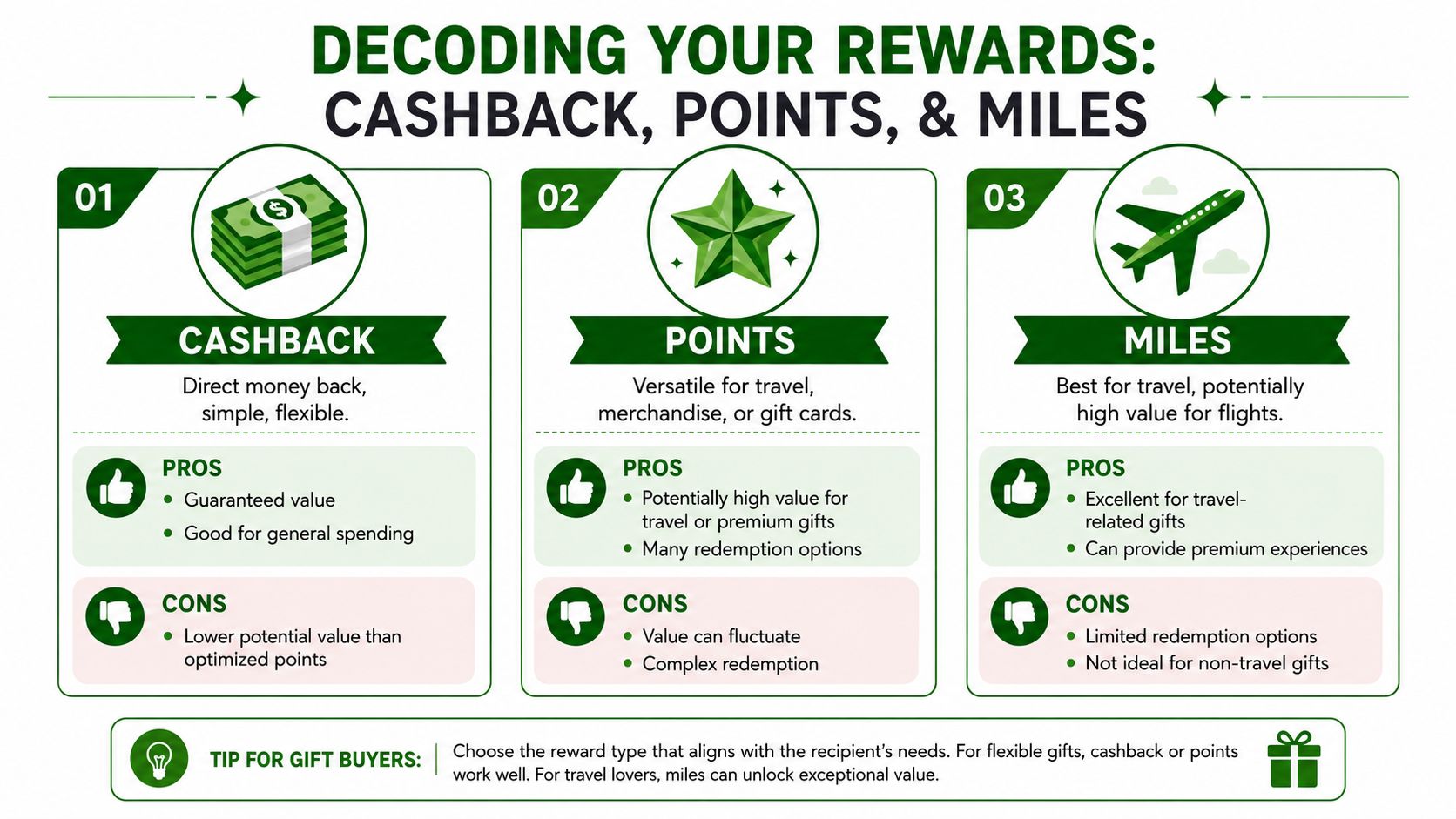
Cashback for straightforward gift budgets
Cash back is the cleanest option for people who buy gifts regularly and don’t want a second hobby managing rewards.
If you’re the kind of shopper who orders birthday gifts, thank-you baskets, and holiday presents throughout the year, cash back turns those purchases into budget relief. The value is easy to understand because the reward is already in dollars. That makes it especially good for households and small teams that want their rewards to offset future spending rather than fund a specific aspirational trip.
Cash back also fits gift cards well. If your main goal is to buy a practical present and move on, the simplicity has real value.
Points for planners who want optionality
Points are more flexible but less intuitive. They can usually be redeemed in several ways, and that flexibility is both the attraction and the catch.
For a corporate buyer, points can be useful because gifting often comes in waves. A large employee-appreciation order today might create a pool of points that later becomes travel, statement credits, gift cards, or another redemption route depending on what the business needs at that moment. For a household, points can serve the same role if your spending is uneven and you don’t yet know whether you’d rather reduce costs or save for something bigger.
The downside is that flexible systems ask more from you. You need to compare redemption options instead of assuming all points are equal.
Miles for people who already travel enough to use them well
Miles are the most specialized currency in the group. They can produce strong value for people who fly regularly or know how to work within airline and travel ecosystems. But for a gift-first strategy, miles are often one step removed from the original goal.
That doesn’t make them bad. It makes them conditional.
If your company sends client gifts all year and then uses the accumulated rewards to cover employee travel, miles can make sense. If you mostly buy gifts for birthdays, family occasions, and thank-you gestures, miles often add complexity without adding much day-to-day usefulness.
A quick comparison for gift buyers
| Reward type | Best fit | Main strength | Main weakness |
|---|---|---|---|
| Cashback | Households, practical shoppers, small teams | Clear value and easy redemption | Lower upside than optimized points |
| Points | Strategic planners, corporate buyers, flexible redeemers | Multiple redemption paths | Value varies and requires analysis |
| Miles | Frequent travelers and travel-heavy businesses | Strong travel-focused potential | Less useful for non-travel goals |
A lot of cardholders choose badly because they choose by aspiration rather than behavior. They like the idea of premium travel, but their real spending pattern looks like groceries, online shopping, recurring bills, and gifts.
If that sounds familiar, it’s worth reading a separate take on choosing the best rewards card because the right answer often starts with whether you value certainty or flexibility, not with which card looks most exciting in an ad.
Your rewards type should match your redemption life. If your rewards will almost certainly become statement credits, a glamorous travel currency may just be a slower version of cash back.
Where niche perks fit in
A useful recent shift in rewards is the move beyond classic airfare-and-hotel perks. Coverage of newer cards shows experiments with rewards in practical or unusual categories such as insurance premiums, gaming and sports app loads, and redemptions that can flow into brokerage deposits, statement credit, gift cards, or travel portals (NerdWallet coverage of under-the-radar card perks).
For gift buyers, that trend matters because it suggests rewards are becoming more personalized and less travel-centric. The strategic question isn’t only “Which card is best?” It’s “Which earning and redemption mix best matches how I buy gifts?”
Calculating the True Value of Your Rewards
Most rewards confusion disappears once you use one metric: cents per point, often shortened to CPP. It answers a simple question. When you redeem points, how much money-like value did each point produce?
That’s the true scorecard.

Why the same point can be worth very different amounts
Regulators note that a reward point’s value isn’t fixed. A point may be earned at a set rate, but its redemption value can vary significantly. Redeeming for cash might yield 1 cent per point, while strategic travel-partner redemptions can reach roughly 1.5 to 2+ cents per point. The key idea is that the redemption channel, not the original purchase, often determines the ultimate value (CFPB circular on credit card rewards design and administration).
That’s why two people can earn points at the same rate and still get very different outcomes.
A simple way to calculate CPP
Use this formula:
CPP = redemption value in dollars ÷ number of points used
Then convert dollars to cents.
A few examples make the point quickly:
- Statement credit redemption: If you use 10,000 points for $100 off your bill, that’s 1 cent per point.
- Higher-value travel redemption: If 10,000 points cover $200 in travel value, that’s 2 cents per point.
- Weak merchandise redemption: If the same points buy merchandise you could have bought cheaper elsewhere, your effective value may be worse than cash.
For gift buyers, this matters because many rewards dashboards push easy redemptions first. Gift cards, merchandise, and checkout credits can feel convenient, but convenience isn’t the same as value.
A practical ranking for gift-related spending
When you earn rewards through gifts, ask what job those rewards should do next.
- Cash or statement credits usually win on simplicity.
- Gift cards can be fine if they redeem at fair value and you’ll definitely use them.
- Merchandise catalogs are often the most dangerous because pricing can hide poor value.
- Travel transfers or premium portal redemptions can be strongest, but only if you’ll use them.
For someone buying personal gifts on a tight budget, a predictable cash-equivalent redemption may be the smartest move even if it isn’t the highest theoretical value. For a business owner who already knows they’ll book travel later, it can be rational to hold flexible points for a better redemption path.
Don’t ask whether a redemption feels good. Ask what the same points could have bought somewhere else.
Strategic Gifting Maximize Rewards on Every Present
Gift buying creates one of the better environments for rewards optimization because the purchases are often discrete, intentional, and tied to a deadline. That makes them easier to route through the right card than diffuse spending categories like “general shopping.”
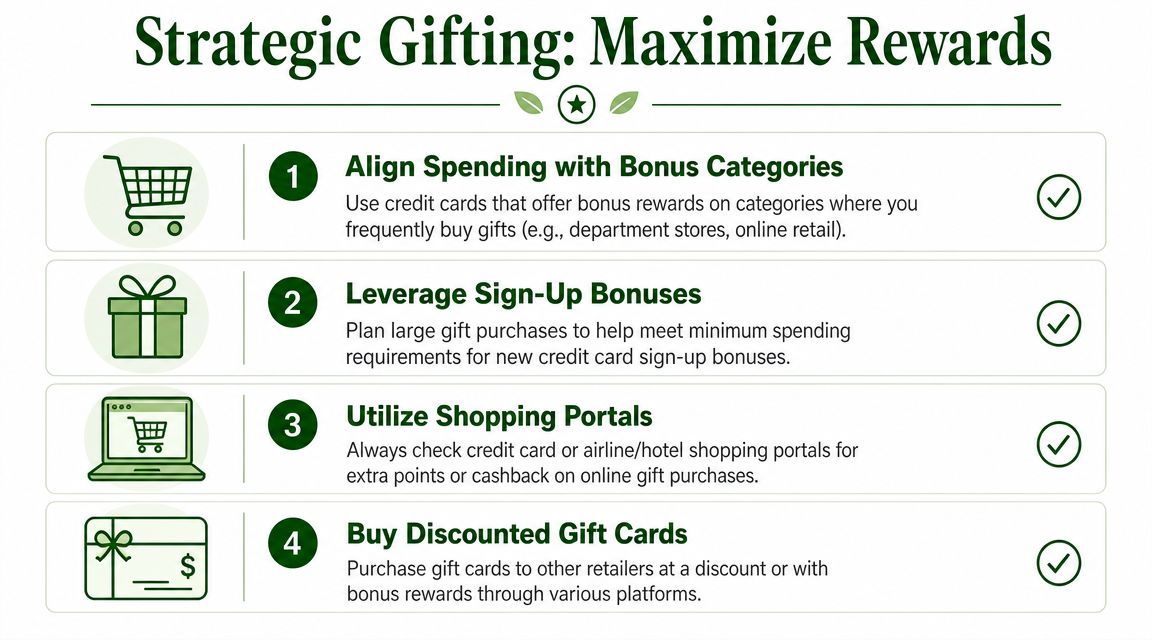
Treat gifting as a portfolio problem
Issuer guidance makes an important point: reward optimization usually works best as a multi-card strategy. Flat-rate cards, tiered cards, and category-bonus cards are built for different spending patterns, and some cards offer large upfront bonuses after a minimum spend threshold. The same guidance also stresses that you should use those cards for predictable, budgeted expenses and pay the statement balance in full, because finance charges can erase the value of rewards earned (Wells Fargo overview of how credit card rewards work).
For gift buyers, that means one card often isn’t enough.
A flat-rate card handles the purchases that don’t fit neatly anywhere. A category card can absorb spending at merchants where you often buy gifts. A new-card welcome offer can make sense when you know a large planned order is coming and you can meet the spending requirement without changing your budget.
Tactics that work especially well for gifts
Match the merchant to the card, not the occasion. A sympathy basket and a birthday set may feel like different purchases emotionally, but if both come from the same type of merchant, they should usually go on the same optimized card.
Use gift timing to your advantage. Corporate gifting is often seasonal. If you know client boxes or employee gifts will be purchased in a concentrated window, that can be the cleanest time to route spend toward a welcome offer.
Look for stacking opportunities. Many issuers and loyalty programs offer shopping portals that can add extra rewards when you click through before buying online. A portal can sit on top of the rewards your card already earns, which is one of the few legitimate ways to “double dip” without spending more.
Use merchant gift cards selectively. If your strongest bonus category is at a supermarket or another bonus-eligible merchant, buying a merchant gift card there can sometimes be a way to redirect value toward a retailer that wouldn’t otherwise earn a premium rate. This only works if the store codes the way you expect and if the gift card doesn’t tempt you into buying more than planned.
Personal gifting and corporate gifting aren’t the same game
A household shopper often wants low friction. If you buy gifts throughout the year, your best system may be one strong everyday card plus one category card used only when it clearly beats the default.
A corporate buyer should think more like a procurement manager. Large orders can justify more planning because the swing in rewards value is larger. If your team sends onboarding boxes, appreciation gifts, and holiday baskets on a repeat schedule, put the dates in a calendar and decide in advance which spend belongs on which card.
That’s also where a discovery platform can be useful. A site like Kudosz organizes gift baskets and themed sets from multiple merchants, which can help you compare the kind of products you’re buying before you decide which card, portal, or redemption strategy fits the purchase.
A workable checklist before checkout
- Confirm the merchant type. Don’t assume an online gift seller will code the way a broad “retail” category suggests.
- Pick the card with the clearest edge. If the difference is marginal, simplicity may beat optimization.
- Check for a shopping portal. Extra rewards are easiest to miss when you’re rushing a time-sensitive gift.
- Use planned spend for bonuses only. Don’t inflate a gift budget to hit a threshold.
- Save the receipt and note the redemption plan. Rewards are easier to use when you decide their job in advance.
Common Pitfalls That Erase Your Hard-Earned Rewards
Rewards marketing highlights the upside. The actual economics are harsher.
A Federal Reserve paper found that in 2019, reward credit cards accounted for 60% of all new credit, and it estimated that the average reward card produced a negative net reward of about $12. The same study estimated that cardholders with positive net rewards earned $1.3 billion per month, while those with negative net rewards paid $4.1 billion, implying an annualized redistribution of $15.1 billion driven by reward credit cards (Federal Reserve paper on the distributional effects of reward cards).
That’s the part many gift buyers miss. Rewards don’t just reward behavior. They sort users into winners and subsidizers.
The biggest mistake is carrying the cost side
If you revolve balances, even a good rewards strategy can turn into a bad financial product. The point of optimizing gift purchases is to extract value from spending you already planned. Once interest and fees enter the picture, the rewards side stops being the main event.
That’s why a disciplined gift buyer often beats an enthusiastic points chaser. The disciplined buyer uses rewards as a rebate on existing spending. The chaser treats rewards as a reason to spend.
Rewards are only valuable after costs. Not before.
Other failure points to watch
- Annual fees without a use case: A premium card can be rational, but only if the ongoing benefits and your likely redemptions justify it.
- Overspending to hit a bonus: Buying a more expensive corporate gift set just to cross a threshold usually means the issuer won.
- Poor redemptions: A weak gift card or merchandise option can cut the value of what you earned.
- Program changes: Issuers can change redemption menus and reward structures, which is why hoarding points without a plan carries risk.
The gift-buyer version of restraint
Gift spending has a built-in emotional hazard. You’re often buying for someone else, on a deadline, with a desire to be generous. That makes it easy to rationalize “a little more” if a bonus is close.
The better move is boring. Set the gift budget first. Then optimize inside it. If the rewards don’t fit the budget, skip the rewards move.
Your Smart Redemption Strategy
The best redemption strategy depends on what role gift spending plays in your life.
If you buy gifts for family and friends throughout the year and want direct budget relief, prioritize cash back or cash-equivalent redemptions. The value is clear, and it keeps your rewards tied to everyday usefulness.
If your spending is heavier, less frequent, and easier to plan, flexible points can make more sense. A business owner or HR manager who buys gifts in batches may want to stockpile points and redeem them only when a clearly better use appears, such as travel or another high-value option.
If you’re still comparing issuers and trying to match rewards structure to your broader banking setup, a roundup of top-rated banks can be a useful starting point because the right redemption strategy often begins with the kind of rewards ecosystem your institution supports.
The broader lesson is simple. Gift buying is rarely optional, but the value you get from paying for it is. When you treat Credit Cards & Rewards as a system instead of a perk, presents start doing double duty.
* Disclaimer: Kudosz is not a financial advisor and our Top 5 Best-Rated ratings are not financial advice. This information is for educational purposes only and does not constitute financial advice. Doing business with any providers noted is at your own risk.