Kudosz Top Ratings ⭐⭐⭐⭐⭐
You get your first real paycheck, a graduation gift, a tax refund, or maybe a work bonus. You open three tabs. One bank says it has a checking account for everyday spending. An app promises faster saving. Another company offers investing in minutes. Suddenly a simple question, “Where should my money go?”, turns into a maze.
That confusion is normal. Money choices rarely arrive one at a time. They show up in bunches. You need a place to park cash, a way to pay bills, maybe a credit card, maybe a starter emergency fund, maybe help figuring out investing. The hard part isn’t that there are no options. It’s that there are too many, and they all sound useful.
Banking and personal finance firms can feel like a private club with too much jargon and too many acronyms. They don’t have to. If you’re trying to sort out everyday money decisions, this guide is meant to translate the industry into plain English and help you choose based on your life stage, your habits, and your actual goals.
Your Financial Starting Line
A common version of this moment looks like this. You’ve just finished school, your first paycheck lands, and you want to “be responsible” with it. Maybe you’re also thinking about a gift for someone who helped you get there, which is why occasion guides like these graduation gift basket ideas can sit in the same browser session as bank reviews and budgeting apps. Real life mixes emotions and money all the time.
The problem usually isn’t motivation. It’s sequencing. Should you open a checking account first, build savings, start investing, pay off debt, or automate everything and stop thinking about it? If you try to solve all of that at once, you’ll probably freeze.
The right first move in personal finance is usually the one that reduces friction in your daily life.
For some people, that means a simple checking account with reliable bill pay. For others, it means separating spending money from emergency savings so they stop dipping into the same pool. If your main struggle is consistency, a practical resource on how to automate your money can help you turn good intentions into a repeatable system.
A useful mindset shift is this. Don’t start by asking, “Which firm is best?” Start by asking, “What job do I need this firm to do for me right now?” That question is smaller, clearer, and much easier to answer.
The Financial Universe A Who’s Who
Thinking about financial firms as a toolbox makes the whole industry easier to understand. You don’t use a hammer for every repair, and you shouldn’t expect one company to solve every money problem equally well.
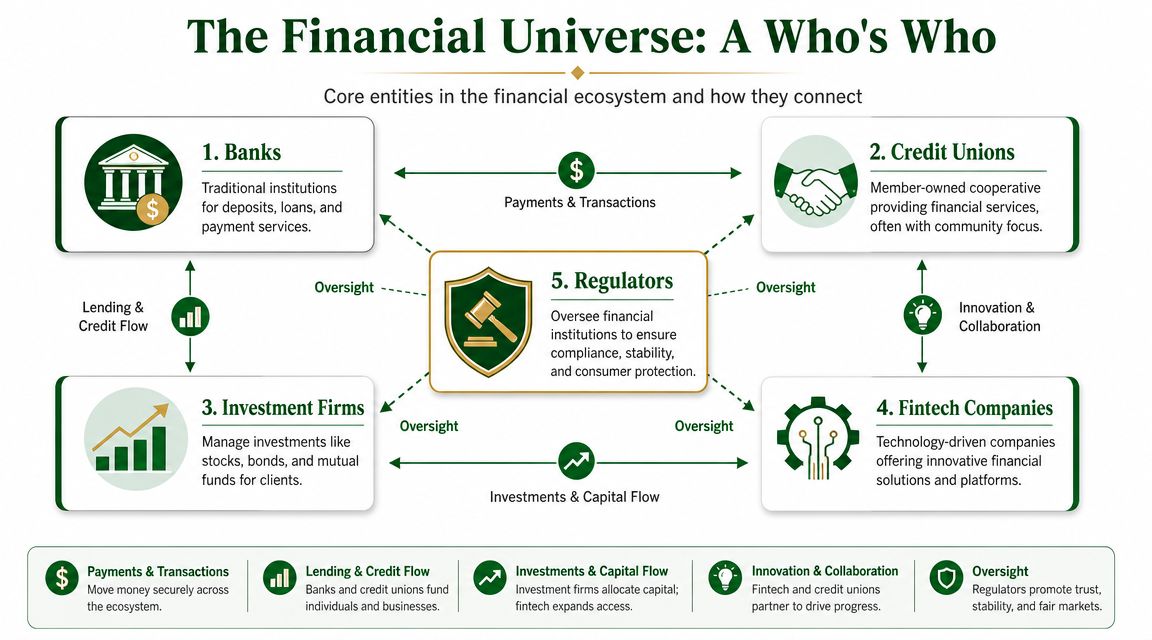
Traditional banks
A traditional bank is the financial version of a department store. It usually offers a bit of everything: checking, savings, loans, credit cards, transfers, and sometimes investment products too.
Scale matters here. The U.S. banking industry is heavily concentrated, with four institutions, JPMorgan Chase, Bank of America, Wells Fargo, and Citigroup, recognized as the dominant players by scale. Bank of America says it serves about 70 million clients across more than 35 countries and has approximately 212,100 employees according to its company fast facts. That size helps explain why big banks often shape customer expectations for apps, branch access, and product bundles.
Traditional banks are often the starting point for everyday consumers because they combine deposits, payments, and borrowing under one roof. If you want one login for most basic money tasks, this is often where you look first.
Credit unions
Credit unions are more like local co-ops than giant department stores. They still offer familiar products, but the appeal often centers on member ownership, community ties, and a simpler service model.
Many people choose a credit union because they want a more personal relationship or because they prefer an institution that feels less sprawling. If you value in-person support and straightforward account use, a credit union can be a strong fit.
Fintech companies
A fintech app is the specialist tool in the box. It often does one thing really well, such as mobile payments, automated saving, online lending, or credit building.
Some fintech lenders also make decisions differently than older lenders. The World Bank notes that modern credit underwriting can use bank transaction data, mobile phone usage, geolocation, point-of-sale transactions, device data, social-media signals, and real-estate data in scorecards that assign points based on statistical analysis, as described in its credit scoring guidance. For consumers with a thin credit file, that can mean a lender looks beyond a traditional bureau score. The tradeoff is that you should pay close attention to privacy, transparency, and dispute handling.
Investment firms and advisors
Investment firms handle a different job entirely. They help people buy and manage assets like stocks, bonds, and funds. Some are full-service advisory firms. Others are low-friction platforms built for self-directed investing.
These firms matter most when your goal shifts from “Where should I keep my cash?” to “How should I grow money over time?” That’s a different question, and it requires a different tool.
Payment firms and platforms
Payment companies focus on movement. They help you send money, receive money, or pay businesses quickly. Their strength is convenience, not necessarily being your full financial home.
That distinction matters. A payment app may be excellent for splitting rent or paying a seller, but it may not be the place where you want to build long-term savings habits.
Banking and finance firm types at a glance
| Firm Type | Primary Purpose | Best For… | Example |
|---|---|---|---|
| Traditional bank | Deposits, payments, lending | People who want one place for daily money management | A large national bank |
| Credit union | Member-focused everyday banking | People who value community service and simpler relationships | A local or employer-based credit union |
| Fintech company | Specialized digital money tools | People who want app-first features or niche solutions | A budgeting, lending, or payment app |
| Investment firm | Building and managing investments | People saving for long-term goals like retirement | A brokerage or advisory platform |
| Payment firm | Moving money quickly | People who need easy peer-to-peer or merchant payments | A digital payment platform |
Simple test: If you need to store money, compare banks and credit unions. If you need to move money, compare payment firms. If you need to grow money, compare investment firms.
Understanding Core Services and Pricing
Financial products often sound free, fast, or convenient. They usually are convenient. They are rarely free in the full economic sense.
What you’re actually buying
A checking account buys access and movement. It lets you receive income, pay bills, use a debit card, and transfer funds. A savings account buys separation and discipline. It creates a place for money you don’t want to spend casually.
A loan buys time. You get purchasing power now and repay it later, usually with interest. A credit card does something similar, but with revolving borrowing and a different pricing structure. An investment account buys access to markets, which means your balance can rise or fall.
How firms make money
The pricing model changes by product. Banks may earn from spreads between what they pay on deposits and what they earn on lending. They can also collect account fees, card-related fees, and service charges. Investment firms may charge account fees, trading-related charges, or an assets-under-management fee.
That’s why comparing only the headline feature can mislead you. A checking account with a slick app may still become expensive if you trigger overdrafts or maintenance charges. An investing app that looks simple may still expose you to market risk or product costs you didn’t notice at signup.
Finance rarely gives away a benefit with no tradeoff. If a product feels free, look for where the firm gets paid.
Why lending decisions can look unfamiliar now
Some people get confused when one lender says no and another says yes. Part of the reason is that firms don’t all evaluate risk the same way.
Modern underwriting can pull from broader behavioral signals, including transaction patterns and device-related data, not only a traditional credit score. That can help lenders assess borrowers who are new to credit or don’t fit old models. It can also make the decision process feel less visible from the consumer side.
When you apply for credit, look past the approval itself and ask a few practical questions:
- What determines the rate: Ask whether the lender relies mainly on bureau data, cash-flow data, or a wider internal model.
- How stable the payment is: Check whether the monthly amount can change, or whether fees can appear after origination.
- What happens if you’re late: A product isn’t only about getting approved. It’s also about what the penalty path looks like if life gets messy.
A quick consumer rule
If you can’t explain how the firm gets paid, pause before signing up. That’s true for bank accounts, investment products, debt consolidation offers, and “instant access” money apps.
The most useful habit isn’t memorizing every fee type. It’s learning to ask, “What is this service costing me in money, flexibility, or risk?”
How Regulation Keeps Your Money Safe
People often hear that money is “protected” and assume that means every financial loss is covered. It doesn’t. A better way to think about regulation is to picture safety inspectors and different types of insurance.

Safety inspectors and rule books
Regulators oversee banks, credit unions, securities firms, and other financial companies. Their job is to enforce rules about conduct, capital, disclosures, and consumer protections. You don’t need to memorize every agency name to use this idea well.
What matters for everyday decisions is whether the firm is operating inside a real regulatory framework and whether you can tell who supervises it. If you can’t figure out who watches the company, that’s not a small detail. It’s a warning sign.
What protection usually means
With deposit-taking institutions, the relevant protection is about what happens if the institution fails. With investment accounts, the issue is different. Protection may relate to the custody of assets and firm failure, not to market losses.
That distinction trips up many people. If your stock fund drops, regulation doesn’t reverse the market. If your insured bank fails, that’s a different event.
Practical rule: Ask one direct question before opening any account. “What exactly is protected, and what is not?”
Questions worth asking before you move money
Use plain language. You don’t need industry jargon.
- Who regulates this firm: The answer should be easy to verify.
- What happens if the company fails: You want a concrete explanation, not a vague reassurance.
- Where is my money held: Especially important with apps and platforms that partner with other institutions.
- How do disputes work: If a transfer goes wrong or a charge looks suspicious, you need a path for recourse.
A regulated product can still be a bad fit. An unregulated or poorly explained product can be much worse. Safety isn’t only about fraud prevention. It’s also about knowing what system you’re standing inside.
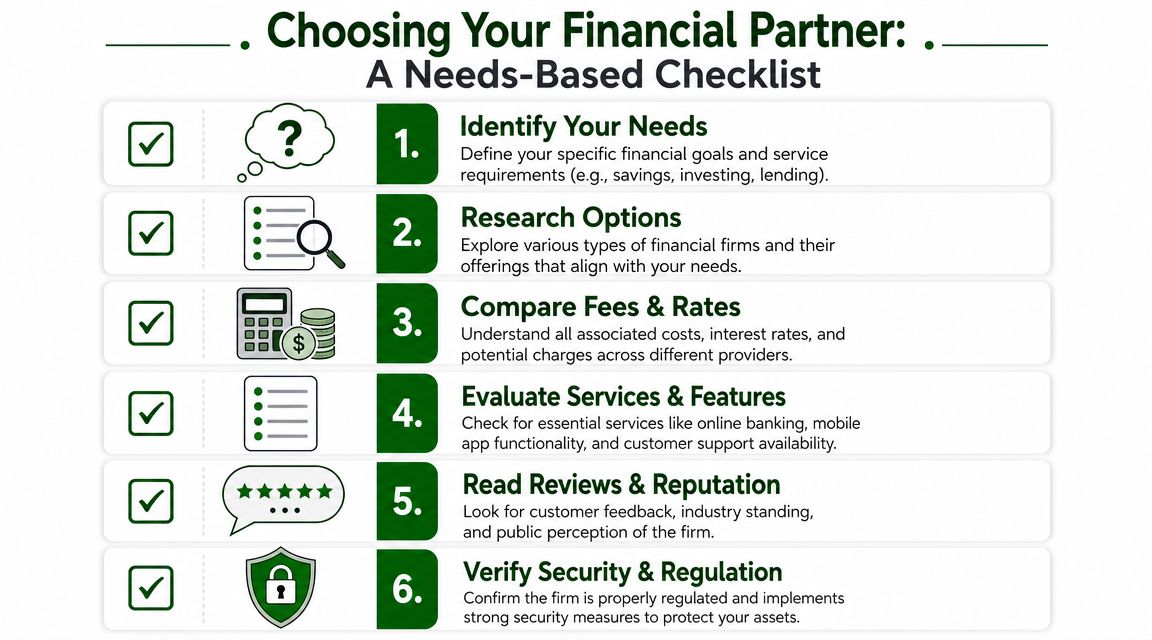
How to Choose the Right Firm for Your Needs
The best firm depends less on branding and more on your current money problem. A student, a new parent, and someone nearing retirement may all need financial help, but not from the same type of provider.
Match the firm to the life stage
If you’re a student or recent graduate, your first priority is often simple cash management. You need a place to receive money, pay bills, and avoid nuisance fees. A no-drama checking account and a separate savings bucket often matter more than advanced investing tools.
If you’re building a household, the questions change. You may need joint account logistics, better bill organization, an emergency fund structure, or eventually a mortgage lender. Convenience matters, but coordination matters more.
If you’re earning steadily and thinking long term, investment access starts to matter more. That’s when a brokerage or advisory relationship may belong in your financial mix, even if your day-to-day checking stays elsewhere.
Solve the actual pain point
For 5.6 million U.S. households that are underbanked, the most helpful products are often not just a basic account but affordable electronic payments and safe ways to accumulate emergency savings, according to this Congressional Research Service summary. That’s a useful reminder for everyone. The best product is the one that solves the costliest problem in your current life.
A checklist you can use today
Before choosing any bank, lender, app, or investment platform, ask:
- What job am I hiring this firm to do: Spending, saving, borrowing, investing, or moving money.
- Which pain point does it reduce: Fees, confusion, delay, lack of discipline, or lack of access.
- What are the total costs: Not just the advertised rate or headline feature.
- How easy is it to get help: Phone, chat, branch, email, or none of the above.
- Can I leave easily: Friction matters. Some accounts are easy to close or transfer. Others make exits annoying.
- Does this fit my habits: A beautiful app won’t help if you ignore notifications and need a branch.
A financial product should make one part of your life easier without quietly making another part riskier.
Common Pitfalls and Financial Traps to Avoid
Many people assume the biggest financial mistake is choosing the “wrong” brand. Usually it’s choosing without understanding the rules attached to the product.
Trap one, buying features instead of outcomes
A flashy dashboard, a signup bonus, or instant approval can distract you from the real question. Does the product improve your finances after the first month? An account that looks modern but keeps triggering avoidable charges isn’t helping you.
This is especially important in underserved communities, where access alone doesn’t solve the problem. Research highlighted by the Center for Financial Inclusion notes that a major barrier is lack of trust in the tools and institutions, not just lack of access. People often avoid services they don’t understand because they fear hidden fees, data misuse, or weak recourse when things go wrong, as discussed in this piece on building trust in underserved communities.
Trap two, treating all distrust as wisdom
Some skepticism is healthy. Blanket distrust can be expensive. If someone avoids mainstream products entirely, they may end up paying more for basic money tasks or relying on tools that offer less protection and less clarity.
The opposite mistake is blind faith in anything with a clean app and smooth onboarding. Trust should be earned through transparency, regulation, understandable pricing, and a clear dispute process.
Trap three, ignoring the fraud angle
If a return or offer sounds too polished and too easy, stop. Frauds often borrow the language of legitimate finance. They talk about exclusive access, guaranteed outcomes, and urgency.
For a plain-English primer on one of the oldest scams in finance, Kons Law explains Ponzi schemes. Even if you’re not investing large sums, understanding the pattern helps you spot manipulative promises faster. And if you’re shopping for a celebration present while sorting through life-admin tasks, even light reading like these birthday gift basket ideas can be a reminder that not every online decision needs to be high stakes. Financial ones do.
Red flags worth taking seriously
- Confusing fee language: If the pricing page reads like a puzzle, assume you haven’t found the full cost yet.
- No clear human support: Problems always seem manageable before they happen.
- Pressure to act fast: Good financial products can survive a day of scrutiny.
- Unclear custody of funds: You should know where your money sits.
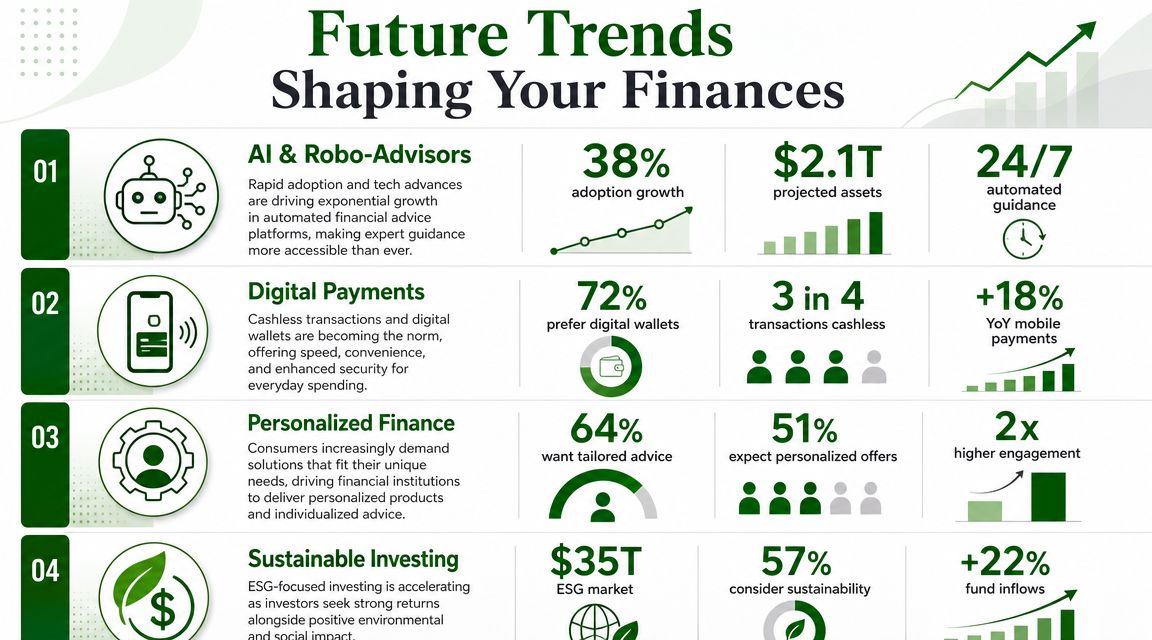
Future Trends Shaping Your Finances
The future of banking and personal finance firms looks more digital, more personalized, and more embedded in ordinary life. You won’t always go looking for financial services. Increasingly, they’ll appear inside the apps and platforms you already use.
What consumers are already telling firms
A recent consumer survey shows how far the shift has moved. 42% of consumers prefer a mobile app to manage finances, 36% prefer online banking, and 18% favor visiting a branch, while 58% rank trust as one of the most important factors when choosing a provider, according to this summary of banking trends statistics. That combination matters. People want speed, but they still want reassurance.
What that means in practice
Expect more automated guidance, more app-based money management, and more financial features built into nonfinancial products. That might mean smarter alerts, easier savings rules, or borrowing options that appear at checkout.
The opportunity is convenience. The risk is passivity. When money tools become frictionless, it’s easier to click before thinking. That’s why the old questions still matter. What problem is this solving? What does it cost? Who regulates it? What happens if something goes wrong?
The tools will keep changing. Your core job won’t. Stay curious, ask plain questions, and choose firms that fit your real life rather than your idealized one.
If you’re comparing financial choices the way you compare any other important purchase, you’re already doing something right. The goal isn’t to find one perfect company forever. It’s to build a money setup that works for the season of life you’re in now, then improve it as your needs change.
* Disclaimer: Kudosz is not a financial advisor and our Top 5 Best-Rated ratings are not financial advice. This information is for educational purposes only and does not constitute financial advice. Doing business with any providers noted is at your own risk.