Nearly 30 million U.S. cardholders now have an airline credit card, and almost one in four U.S. households has one, according to an Airlines for America analysis. That turns airline miles credit cards from a niche perk for road warriors into a mainstream financial product with real household tradeoffs.
The catch is that most advice still assumes you fly constantly, chase elite status, and treat points like a hobby. Many people don’t. They take one or two trips a year, travel with kids, split flights across airlines, and care less about lounge selfies than checked-bag fees and easier booking.
That gap changes how you should evaluate these cards. For frequent flyers, the right question is often how to maximize miles. For occasional travelers and families, the smarter question is simpler: Will this annual fee pay for itself through the perks you’ll use?
Here’s a quick framework before the deeper analysis.
| Traveler type | Best-fit card strategy | Why it tends to work | Main risk |
|---|---|---|---|
| Loyal solo flyer | Co-branded airline card | Airline-specific perks can matter every trip | You’re tied to one network |
| Occasional couple | Flexible travel card first | Easier redemption across multiple airlines | Fewer airline-specific perks |
| Family checking bags | Airline card can make sense if you use the bag perk regularly | Practical savings may outweigh the fee | Value falls fast if you switch airlines |
| Award optimizer | Mix of flexible points and one airline card | Access to both transfer options and airline perks | More complexity to manage |
| Infrequent traveler | Usually start with flexibility, then add airline card only if a clear perk justifies it | Avoids paying for benefits you won’t use | Easy to overpay for a shiny sign-up offer |
How Airline Credit Cards Actually Work
Airline miles credit cards sit at the intersection of banking, payments, and loyalty. You swipe the card for groceries, gas, or airfare. The bank manages the account and buys miles from the airline. The airline issues those miles into your frequent-flyer account, and you later redeem them for flights or related travel benefits.
That arrangement has been huge for a long time. A major IdeaWorks analysis estimated that the seven largest U.S. airline frequent-flier programs had about 16.8 million card accounts, generated roughly $337 billion in annual charge volume, and produced more than $4 billion a year for airlines from selling miles to banks, as detailed in this IdeaWorks report. The same report said average annual charge activity per active account ranged from $15,300 to $22,900.
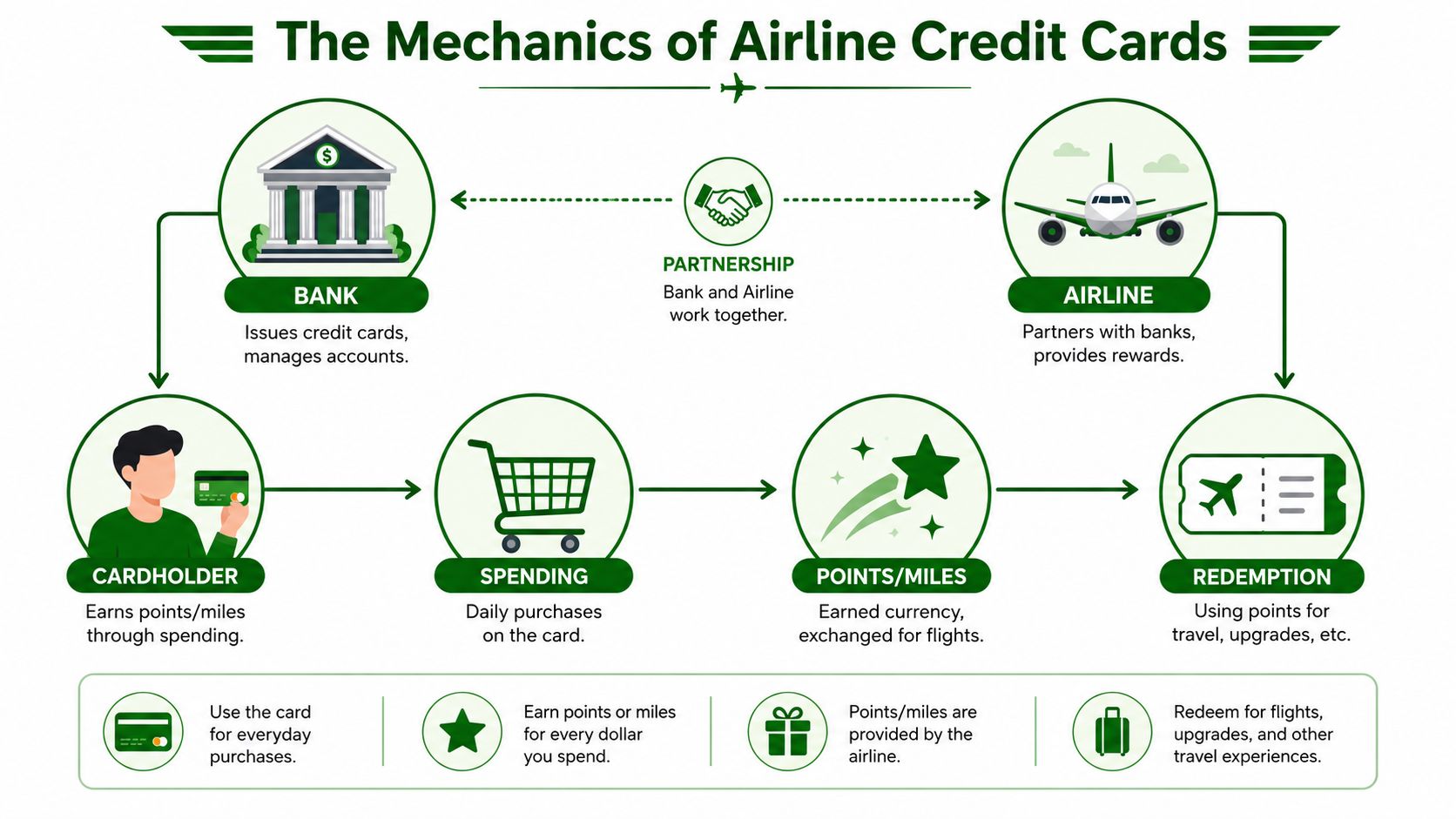
The three-party model
The simplest way to think about the product is this:
- The bank issues the card and earns money from interest, fees, and payment processing.
- The airline supplies the rewards currency and gains a lucrative loyalty business.
- The cardholder turns everyday spending into miles and, ideally, travel savings or convenience.
That sounds straightforward, but one practical distinction matters more than most marketing copy admits.
Co-branded cards versus flexible travel cards
A co-branded airline card is tied to one carrier. Think of the general structure of products linked to United, Delta, American, Southwest, or Alaska. You usually earn miles in that airline’s program, and the best perks often apply only when you fly that carrier.
A general travel rewards card earns flexible points instead. Those points may be redeemed through a bank’s travel system or transferred to multiple airline partners, depending on the card.
Practical rule: If your spending is ordinary but your airline loyalty is inconsistent, flexibility usually matters more than a large mileage balance in a single program.
For readers comparing the wider travel-card market, Explore Effortlessly travel card insights offer a useful companion view on how broader travel cards fit into real-world spending.
The important insight is that airline miles credit cards are not just rewards products. They’re distribution tools for loyalty. Banks want your spending. Airlines want your future booking behavior. You want enough value back to justify the commitment. Whether that deal works depends less on the welcome bonus than on how often you can use the airline-specific perks.
The Central Choice Loyalty Versus Flexibility
The most important decision isn’t which airline card to pick. It’s whether you should pick an airline card at all.
A co-branded airline card asks you to accept narrower rewards in exchange for deeper benefits inside one ecosystem. A flexible-points card does the opposite. It gives you more ways to redeem and fewer carrier-specific privileges. That tradeoff shapes everything else.
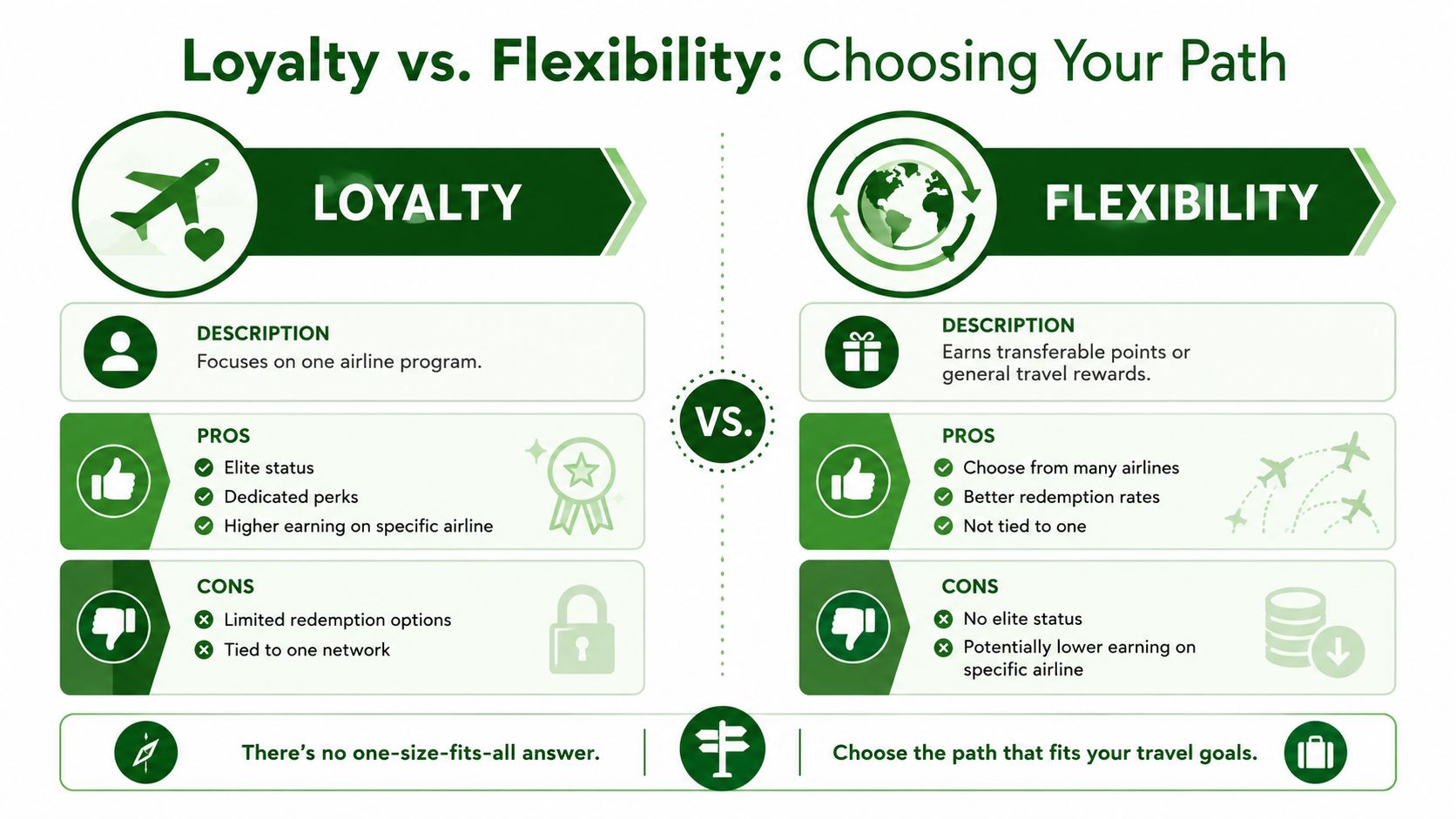
When loyalty wins
Loyalty works best when your travel pattern is predictable. Maybe you live near a hub dominated by one airline. Maybe your employer books you on the same carrier repeatedly. Maybe your family always chooses the same airline because its schedule is easiest from your airport.
Expert reviews note that miles typically post to a single linked frequent-flyer account, which means network alignment and single-airline loyalty are key operational metrics when judging expected value, especially for people who regularly fly the same carrier or alliance, as discussed by 10xTravel’s airline card review guide.
That detail sounds minor, but it changes the economics. If your household spreads paid flights across several airlines, one co-branded card may leave you with a pile of miles in one account and not enough practical use for them. If you reliably fly one airline, the same structure becomes an advantage.
A loyalty-first setup often makes sense when you care about:
- Operational perks like checked bags, boarding position, or in-airline discounts
- Status adjacency, where card benefits work better because you already fly that carrier often
- Simpler redemption habits, especially if you don’t want to learn multiple transfer programs
A good rule for loyalty is consistency, not intensity. You don’t need to be a weekly traveler. You do need to be a repeat customer of the same airline.
Later in the decision process, this visual summary helps keep the tradeoff clear:
When flexibility wins
Flexibility is the stronger default for occasional travelers, couples who shop for fare deals, and families whose routing changes by trip. You’re not locking your rewards life to one carrier’s award pricing, route map, or schedule.
That doesn’t mean flexible points are automatically more valuable. It means they are often more forgiving. If one airline has poor award space or inconvenient times, you still have alternatives. That can matter more than a free boarding group.
The less certain you are about which airline you’ll fly next year, the more expensive loyalty becomes.
A side-by-side decision lens
| Question | Loyalty card tends to fit | Flexible card tends to fit |
|---|---|---|
| Do you fly the same airline often? | Yes | No |
| Do airline-specific perks matter every trip? | Yes | Sometimes not |
| Do you compare fares across carriers? | Less often | Frequently |
| Do you want simple redemptions in one program? | Yes | Not necessarily |
| Are you worried about getting stuck in one ecosystem? | Higher risk | Lower risk |
The overlooked point is this: flexibility protects inconsistent travelers from overcommitting. Loyalty rewards consistent behavior. If you’re an occasional traveler, that distinction is often more important than earning speed.
Essential Features to Compare Before Applying
Marketing for airline miles credit cards tends to spotlight the welcome offer. That matters, but it’s rarely the deciding factor after the first year. Long-term value comes from the interaction between earn rates, perks, fees, and your own travel pattern.
Start with the earn-rate map
Category earnings vary widely. Current examples in the market show airline-branded cards earning anywhere from 1x to 10x miles depending on purchase type, and one comparison lists a United card earning 10x total miles on eligible United flights and 4x miles on other eligible United purchases, according to Credit Karma’s airline card comparison.
That should change how you read offers. A card with a flashy airline bonus but weak everyday categories may underperform a card that rewards the spending you do.
Ask three concrete questions:
- Where is the bonus concentrated? Some cards reward only direct airline spending.
- Do bonus categories match your budget? Dining, gas, hotels, and transit can matter more than airfare for many households.
- Is the high earn rate broad or narrow? A 10x category sounds dramatic, but if it applies only to a limited booking channel, it may be less useful than a lower but wider bonus.
Compare the fee against perks, not hopes
Many occasional travelers often make the wrong bet. They assume miles will eventually justify the annual fee, even if they rarely fly the airline. In practice, recurring perks often matter more.
Think about:
- Checked bag value for your travel party
- Priority boarding if overhead-bin access reduces stress
- Companion-oriented perks if you usually travel as a couple or family
- Travel protections if you book prepaid trips
If you want a cleaner view of the banks behind many major rewards products, Kudosz has a practical roundup of top-rated banks that can help when you’re comparing issuers as well as cards.
Airline Card Archetype Comparison
| Feature | No/Low-Fee Card (Sub-$100) | Mid-Tier Card ($95-$250) | Premium Card ($450+) |
|---|---|---|---|
| Annual fee pressure | Easier to justify | Needs regular use of perks | Needs deliberate benefit capture |
| Typical target user | Beginner or infrequent traveler | Repeat leisure traveler | Frequent flyer or perk maximizer |
| Earning structure | Usually simpler, fewer elevated categories | More likely to include useful airline and travel bonuses | Often strongest on in-brand travel and premium benefits |
| Checked-bag usefulness | Sometimes limited or absent | Often central to the value case | Usually included, but fee is much higher |
| Redemption strategy | Basic airline use | Better if you fly that carrier several times a year | Best for travelers who use multiple premium benefits |
| Main decision question | Is there any downside to keeping it? | Will recurring perks offset the fee? | Will I actively use the premium extras? |
A practical checklist before you apply
Some card comparisons are easier if you score each offer against your own habits.
- List your likely airline usage. One carrier most of the time, or a rotating mix?
- Mark the perks you’d definitely use. Not the ones that sound nice. The ones you’d use.
- Match bonus categories to real spending. Dining-heavy households often need a different card than suburban commuters.
- Ignore the first-year excitement for a moment. Ask whether you’d keep the card after the bonus posts.
- Check whether a flexible card would solve the same problem with fewer restrictions.
A good airline card isn’t the one with the loudest bonus. It’s the one you’d still defend on renewal day.
Finding the Right Card for Your Travel Profile
The most useful way to judge airline miles credit cards is to stop thinking in card names and start thinking in travel profiles. Different households extract value in different ways, and the same annual fee can be smart for one person and dead weight for another.
Experian’s guidance highlights a major blind spot in this market: non-frequent flyers need a break-even analysis, especially when annual fees are under $150, because the value often depends more on practical perks than on miles alone, as noted in this Experian overview of airline cards.
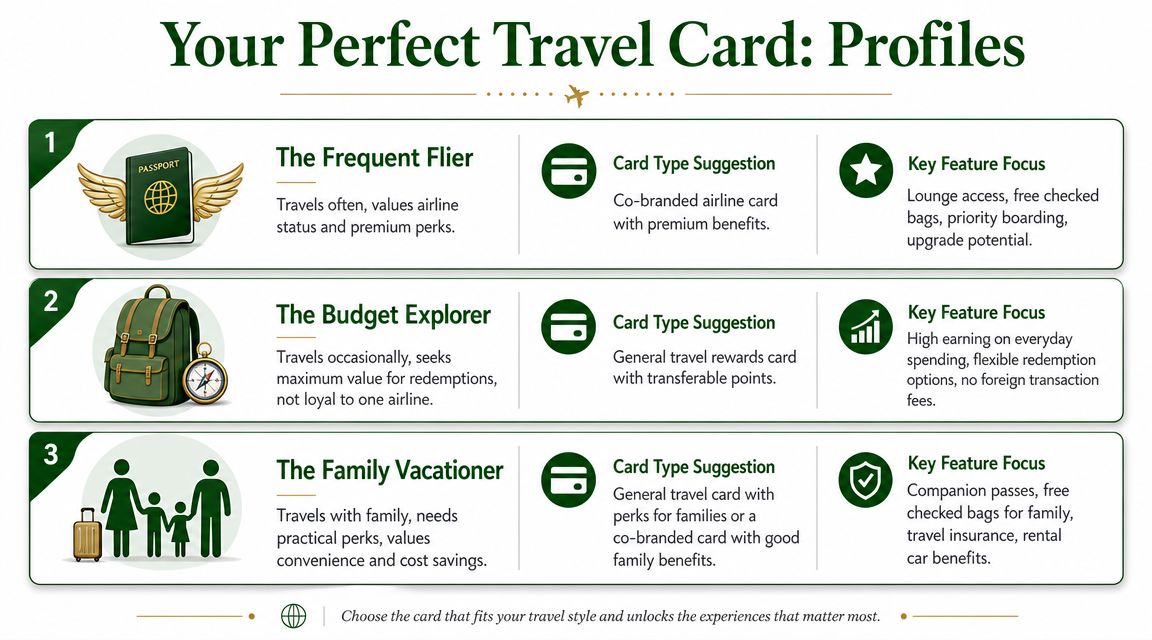
The hub-loyal business traveler
This traveler flies from the same airport, often on the same airline, and values time more than flexibility. They don’t need a perfect redemption spreadsheet. They need a smoother airport routine and a card that reinforces existing behavior.
For this profile, a co-branded airline card often fits because the airline ecosystem already matches the travel pattern. Network alignment does most of the work. The card merely layers on convenience.
What matters most here:
- Airline-specific earning
- Priority-oriented perks
- Status-linked utility
- Consistency of route network from the home airport
This traveler can justify a richer annual fee more easily because usage is repetitive.
The annual family vacationer
This is the group most card guides shortchange. A family may fly only a few times a year, but each trip comes with baggage, seating concerns, and enough logistics that one practical perk can matter more than a big pool of miles.
The right question is not “How many miles will we earn?” It’s “Can one recurring perk offset the fee without heroic effort?”
If your airline card includes a free checked bag benefit, the break-even test is straightforward in concept even without quoting bag-fee figures here: compare the annual fee with what your family would otherwise pay to check bags on the trips you realistically expect to take. For a family that checks bags on even a modest number of flights with the same airline, the card may justify itself quickly. If your family uses different carriers depending on destination or fare, the value can disappear just as quickly.
That makes this profile unusually sensitive to behavioral consistency. The family doesn’t need to be frequent. It needs to be predictable.
For broader context on how firms and financial providers shape consumer choices around money tools, this Kudosz guide to banking and personal finance firms is a helpful background read.
For many families, the free checked bag is the real product. The miles are a bonus.
The aspirational award seeker
This traveler likes the idea of turning spending into a big future trip. They may not fly constantly, but they’re willing to plan ahead and learn how redemptions work.
A pure airline card can still work here, but only if the chosen airline lines up with likely routes and goals. Otherwise, a flexible-points card is usually the safer base strategy because it preserves options while the trip plan evolves.
This profile should focus on:
- Redemption access, not just accumulation
- Transfer optionality if destination plans aren’t fixed
- Patience, because aspirational bookings often require flexibility in dates or routing
The hidden decision test for occasional travelers
If you fly only once or twice a year, airline miles credit cards can still make sense. But the burden of proof is higher.
A mid-tier airline card is often worth considering when all three of these are true:
- You already expect to fly the same airline
- You’ll use a practical perk such as checked bags or boarding benefit
- You can see a plausible year-two reason to keep the card
If even one of those conditions is weak, a flexible travel card usually starts ahead. That’s the core conclusion many occasional travelers miss. The issue isn’t whether airline cards are good or bad. It’s whether your real travel behavior is stable enough to access their narrow advantages.
Tips for Maximizing Your Card’s Value
The biggest gains usually come from behavior, not from squeezing every last mile out of a chart.

Use the card with intention
A few habits make a noticeable difference:
- Time your application around real spending. A planned trip, insurance bill, home repair, or annual expense can help you meet a welcome-offer requirement without waste.
- Route bonus-category spending carefully. If your airline card is strong on direct airline purchases but weak elsewhere, don’t force all spending onto it.
- Track your renewal date. The decision to keep or cancel should happen with a list of perks used, not vague optimism.
Stack where stacking is easy
You don’t need advanced travel hacking to improve returns. Start with simple combinations:
- Use airline shopping and dining programs when they align with purchases you’d make anyway.
- Pair card perks with existing status if you already fly enough to have it.
- Check partner redemption options before cashing out miles in the most obvious way.
If you’re building a broader strategy beyond a single card, this guide on how to maximize your travel rewards offers a useful overview of loyalty-program thinking.
Keep the math simple. If a tactic adds complexity but doesn’t clearly improve your travel outcome, skip it.
Protect the value you’ve earned
Miles are most useful when you stay organized. Link the card to the correct frequent-flyer account, watch for unused credits or expiring certificates, and redeem with a specific travel goal in mind. Airline miles credit cards reward attention, but they don’t require obsession.
Frequently Asked Questions About Airline Cards
Are premium airline cards ever worth the high fee
Sometimes. The break-even test is straightforward. Add up the benefits your household is likely to use in a normal year, then compare that total with the annual fee.
For occasional travelers and families, the answer often comes down to a few repeatable perks rather than aspirational ones. A free checked bag, priority boarding for a group, or an annual companion benefit can justify the fee faster than lounge access that gets used once. If you need perfect timing or extra trips to make the math work, the card is probably too expensive for your actual travel pattern.
What happens to my miles if I cancel the card
Usually, miles earned from an airline card are transferred into your airline loyalty account, where they remain subject to that program’s rules. That means canceling the card does not always mean losing the miles.
The catch is in the extras. Companion certificates, statement credits, elite-qualifying boosts, and anniversary perks often disappear when the account closes. Check what lives with the airline and what stays tied to the card before you cancel.
Can I use my miles for family members
Often, yes. Many airlines let you book an award ticket for another traveler from your own account, which makes miles more practical for households than many beginners assume.
The harder part is usually availability. If you need four seats on the same flight during school breaks or holidays, the number of miles in your account may matter less than whether the airline has award seats open.
Why do airline card rewards matter so much to the travel industry
They are a large part of how airline loyalty systems function. In 2022, airline credit card reward redemptions drove more than 15 million domestic visitors, supported 183,000 jobs, and contributed $23.43 billion in nationwide economic activity, according to A4A’s 2023 release. The same analysis said 63% of total frequent-flyer miles earned came from these cards.
That scale helps explain why card issuers and airlines put so much weight on welcome offers, co-branded perks, and loyalty retention.
Should occasional travelers skip airline cards entirely
No. They should be more selective.
A family that takes one or two trips a year on the same airline may still come out ahead if baggage fees alone exceed the annual fee. A traveler who splits trips across several airlines usually does better with a flexible travel card, even if the airline card has a bigger headline bonus. The right choice is less about how appealing the perks sound and more about whether they repeat often enough to create a clear surplus.
Airline miles credit cards work best when the value is easy to predict. For many households, that means choosing cards with perks you can use on an ordinary trip, not benefits that require a highly specific itinerary. If the fee is covered by savings you can count on, the card earns its place in your wallet. If not, flexibility is usually the better deal.
* Disclaimer: Kudosz is not a financial advisor and our Top 5 Best-Rated ratings are not financial advice. This information is for educational purposes only and does not constitute financial advice. Doing business with any providers noted is at your own risk.